2 Thessalonians 2:1-2 (ESV)
1 Now concerning the coming of our Lord Jesus Christ and our being gathered together to him, we ask you, brothers, 2 not to be quickly shaken in mind or alarmed, either by a spirit or a spoken word, or a letter seeming to be from us, to the effect that the day of the Lord has come.
These two verses provide the context for this chapter. The context is related to the coming of the Lord, the gathering of His people together with Him and detailed information about the antichrist.
It is my personal belief that contained in this chapter is the biggest problem for the scriptural basis of a pre-tribulation rapture. There are many more, but verse 3 of this chapter is the most verifiable “one verse” place that concludes the argument for me.
Last week, we studied Daniel 9:24-27. From those verses, we learned that there is a last 7 year period, which will mark the end of this age. Many things will be occurring during this short period of time that will prepare the turning of the page from this age into the Millennial Reign of Christ.
Examples would be:
the signing of the covenant that starts this period (Daniel 9:27),
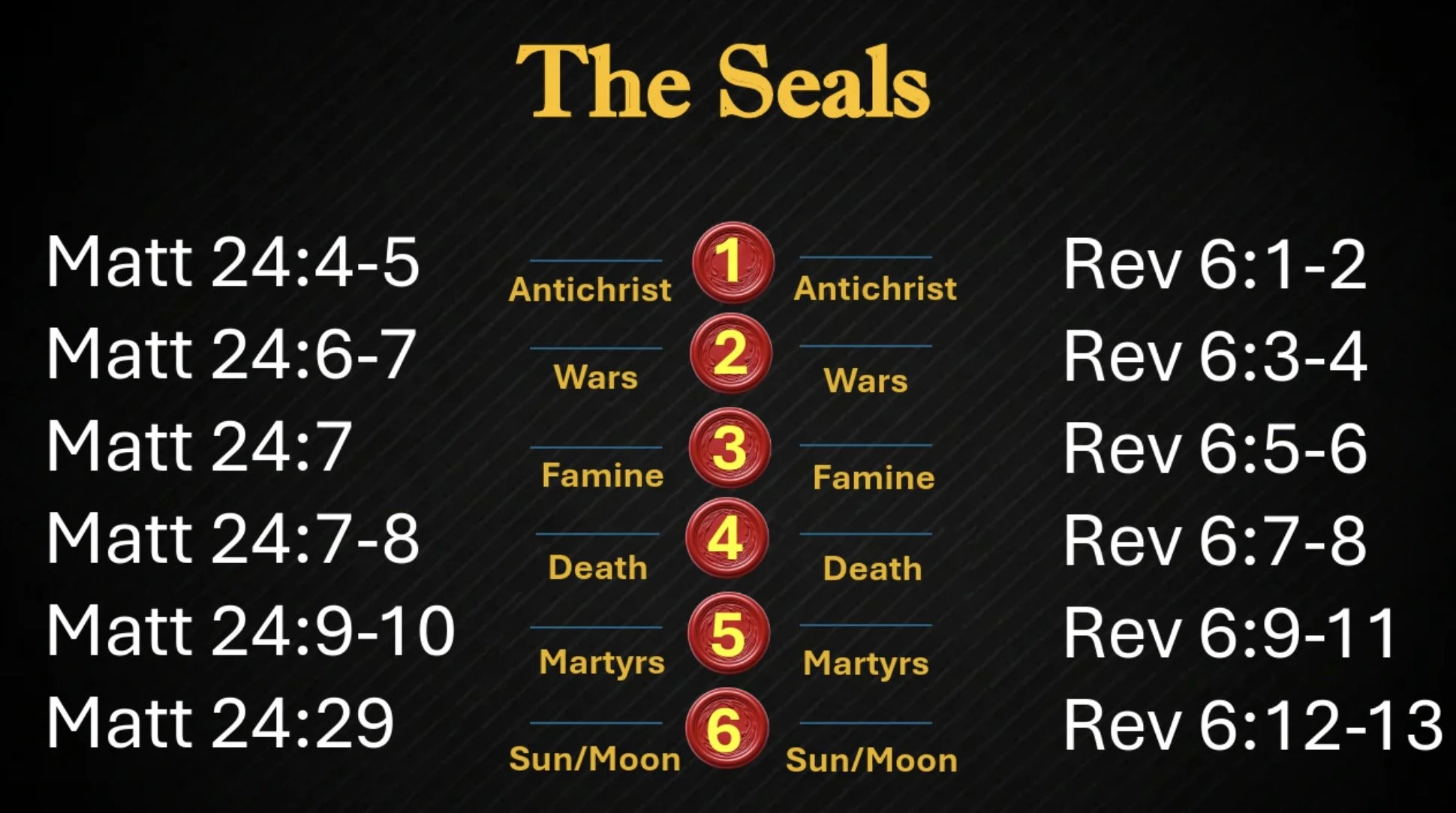
the successive opening of the seals (Revelation 5-6), (by seal 5 [Revelation 6:9]), the mark will have been instituted,
which means that the man of sin will have placed himself in the temple of God and demanded to be worshipped (Matthew 24:15; 2 Thessalonians 2:4).
. The next event would be seal 6 (Revelation 6:12-8:1), which will cause great phenomena in the natural world. The sun will become black and the moon red and there will be a horrific earthquake.
. It will be between seal 6 and 7 that the rapture will occur in my opinion.
. The opening of seal 7 (Revelation 8:1) signals an angel to blow the first trumpet, which begins the pouring out of God’s wrath. The wrath of God is progressively intensified between the blowing of the trumpets and the pouring out of the vials. This time is culminated with the
Battle of Armageddon (Revelation 19; Isaiah 63:2-6; Revelation 14:18-20), where a heavenly army made up of angels (Matt 25:31; 2 Thessalonians 1:7) and glorified saints (Revelations 19:14, 15) will return with the Lord as He destroys the rebellious nations with the sword that protrudes from His mouth. This will mark the end of the age that we know as the church age, but even more significant, it will mark the end of the way that the world we live on has operated since the waters from the flood abated and God started anew.
In reference to the signing of the covenant, let’s dig a little deeper, since we have covered this in relative detail through Daniel 9:27. (In my opinion), the signing of the covenant will likely occur simultaneously with the opening of the first seal. I do not mean to get too wordy here, but these distinctions matter to me.
The first seal is the rider on the white horse. This rider is the antichrist. I would imagine all evangelical commentators who have any reputation would agree that the first rider on the white horse (Revelation 6:2) is the antichrist and is not to be confused with the rider on the white horse in Revelation 19, which is Jesus, the glorified King!
I have never heard another teacher say it this way, but to me this is how he will be revealed initially- through the signing of the covenant, and in my opinion, many will miss this clue. What I mean is that the signing of this covenant will be deceptive and most will not realize who he is yet; however, whether people realize what is happening or not, this will trigger the seals being opened, and once they are opened, there is no stopping the progression to the end. As the seals are opened, it will become painfully apparent that things have shifted. All nations will feel this impact, and while many Christians will still be deceived, others will begin to realize that catastrophe is at the door.
Pre-tribulation adherents do not concern themselves much with this Biblical information simply because they are told, and choose to believe, that they will not be here during this timeframe. In many cases, these proponents (teachers who believe this) teach the rapture will have either already occurred or that it will occur somewhat simultaneously with the signing of this agreement.
The most common or prevalent end time terminology refers to this last 7 year period as the “Great Tribulation.” In my opinion, it is important at this point to draw a distinction. For me, there is not a problem with referring to this last 7 year period as the proper name The Great Tribulation. However, it is extremely important that we clarify some details: 1) there is a difference between tribulation and wrath. Tribulation can be caused by man. For instance, men can stop the shipping of cargo, such as wheat or other commodities and cause famine. In addition, men can foment (instigate) war. Surely, you get the point.
However, The Wrath of God and the word tribulation used as an adjective are not the same. What I mean is that there will be [g]reat [t]ribulation throughout the entire 7 year period. [Jesus said these words in Matthew 24:21). This is likely where the proper name The Great Tribulation came from, but in this passage, it is in the lower case (little g and little t) meaning that He is simply describing the great turmoil throughout this 7 year period.
However, distinguishing the difference between tribulation (little t) and wrath is of utmost importance because pre-tribulation preachers lump it altogether, but there is a huge difference in technicality when it comes to the timing of the rapture.
The scripture says that we are not appointed to wrath (1Thessalonians 5:9), and the reason why is that Jesus took the wrath we deserved when our sin was placed on Him, and He died in our place. However, Jesus, Himself, told us that we will endure tribulation. It’s important to note that I’m not inferring that He is referring in (John) specifically to the Great Tribulation. Instead, He is saying that believers are not immune to the tribulations of life that befall this fallen earth (John 16:33)
Start teaching from here the above is lagniappe
2 Thessalonians 2:1-2 (ESV)
1 Now concerning the coming of our Lord Jesus Christ and our being gathered together to him, we ask you, brothers, 2 not to be quickly shaken in mind or alarmed, either by a spirit or a spoken word, or a letter seeming to be from us, to the effect that the day of the Lord has come.
Verse 2 reveals that the church in Thessalonica were being told and had even possibly received a fraudulent letter with Paul’s name on it saying, “The Day of the Lord has come!”
But our focus is on verse 1. Notice how there is terminology referring to two thoughts: 1) the coming of our Lord and 2) our gathering together with Him. I placed a significant amount of information to help with understanding this thought in the notes above.
The last 7 year period will contain many moving parts that will culminate the end. When we use the terminology, last days, it encompasses what we are feeling now, but even more significantly refers to the last 7 years. In a similar fashion, when there is terminology related to the Day of the Lord, it is specifically related to the beginning of God’s wrath; however, one day to the Lord is like a thousand and a thousand like one day, so the scriptures often refer to the Day of the Lord in more general terminology relating to the last days.
Here, it is clear that the Holy Spirit through Paul is referring to the last days but specifically to the rapture of the church. This is verified by the terminology and our being gathered together to Him.
The word used for this whole phrase is ἐπισυναγωγή episyngoge. As usual, this is a compound word in the Greek and is broken down this way: epi— upon and synagoge- gather
The word synagoge is where the word English word synagogue is derived, which meant a gathering of people that had the same beliefs regarding the Jewish scriptures. The added word epi while most often used as a preposition meaning upon has additional meaning in the Greek language. Prepositions in Greek have additional uses and are often used to reveal deeper meaning. Specifically, the word epi (upon) can mean completeness in the sense of culmination or coming to an end.
So this verse is specifically referring to that part of the end of the age that relates to the final gathering together of those believers who were likeminded through the ages in God’s plan for mankind.
2 Thessalonians 2:3 (KJV)
3 Let no man deceive you by any means: for that day shall not come, [except there come a falling away first], [and that man of sin be revealed], the son of perdition;
That day refers to the rapture of the church. Let no one deceive you he says THAT day will not come except there is a falling away first and that man of sin be revealed. We will separate the thoughts [falling away] and [the man of sin] in a moment, but first, let’s dissect the falling away into two time frames:
The following two translations use two different words for the falling away. One uses rebellion and the other uses apostasy. In a sense, the word apostasy is likely the best choice, and I will explain that in a moment, but the terminology falling away and rebellion are helpful to distinguish the two thoughts that we are currently dealing with.
Examples showing the different word usage
3 Let no one deceive you in any way. For that day will not come, [unless the rebellion comes first], [and the man of lawlessness is revealed], the son of destruction, (2 Thessalonians 2:3 (ESV)
3 Let no one in any way deceive you, for it will not come [unless the apostasy comes first], [and the man of lawlessness is revealed, the son of destruction],
2 (Thessalonians 2:3 (NASB)
1. The first aspect of the rebellious falling away that can also be called apostasy that I want to refer to has to do with a general falling away from the faith that we are warned will happen in the last days. These times will be filled with a love for self more than a love for God (2 Timothy 3:1-4).
These times will be filled with the twisting of truth that will be led by the doctrines of demons (1 Timothy 4:1-2).
The love of self and the love for happiness of self will draw the hearer to find preachers that will make them happy. The truth convicts and conviction doesn’t feel good to a person who refuses to truly repent of their sin, so what they will do in the last days is search for themselves preachers that will tell them pleasant words that they want to hear (2 Timothy 4:3).
The scripture also warns us that men have always been known to deceitfully handle the word of God, causing confusion in people’s lives and turning their walk with God into the similar motions of a wave on the ocean that is tossed whichever way the wind blows (Ephesians 4:11-16).
These people won’t even know this is happening to them because Satan is deceiving them away from the simplicity of Christ— meaning a message focused on Christ (1 Corinthians 11:1-4).
2. The second falling away brings us to Jesus’ Olivet discourse in Matthew 24
Let’s review Matthew 24:1-14. The main verse that I wanted you to see was:
Matthew 24:10 (ESV)
10 And then many will fall away and betray one another and hate one another.
This is the specific falling away, also known as the rebellion or the apostasy that will take place once the Great Tribulation begins with the opening of the first seal.
Back to 2 Thessalonians 2:3 and the fact that the day of the rapture cannot take place unless two things happen:
There is a great falling away
The man of sin is revealed
2 Thessalonians 2:3 (NASB)
3 Let no one in any way deceive you, for it will not come [unless the apostasy comes first], [and the man of lawlessness is revealed, the son of destruction],
I purposefully chose the NASB as the source for this verse because of the word apostasy. The specific Greek word here is apostasia—defection from truth, falling away, to forsake.
The pre-tribulation position is forced to take a position on this scripture that is not consistent with the Bible. Several pre-tribulation authors make the claim this phrase would have been better translated …that day will not come until the taking away and the man of sin is revealed. But the Greek word apostasia means to defect or to fall away not take take away, so they are saying that it’s referring to the Rapture itself. This makes even less sense when we think about it, because then it would be saying, “That day [ie the Rapture] will not take place until two things happen first 1. The taking away [the Rapture] and 2. The man of sin is revealed.
Conclusion
Daniel 12:7-11
In these verses, the angel describes a time on earth when Israel’s power will be shattered and the prophecy of Daniel 9 will come to an end.
During these last days many will heed truth and purify themselves while the wicked will continue in their sin. Only the wise will understand.
Daniel 12:12 (ESV)
12 Blessed is he who waits and arrives at the 1,335 days.
This verse says that the person who makes it to the 1335 days is blessed. 1335-1260=75
I believe that once antichrist breaks covenant and reveals who he really is to the world, there will be a 75 day period before the rapture. This coincides with the words of the Lord:
Matthew 24:22 (ESV)
22 And if those days had not been cut short, no human being would be saved. But for the sake of the elect those days will be cut short.