#15 Jesus Gives Gifts to His Body, Part 2

Jesus Gives Gifts to His Body: Part 2

Evangelist
 
Paul was an evangelist can you see him and Silas in the prison. Right after Lydia the seller of purple, the first European convert gets saved, they're in the streets preaching the gospel. And Paul casts the devil out of that young girl who was filled with the spirit of Python, a spirit of divination or fortune telling. And because of that they get thrown into jail because with the demon gone, she could no longer tell people their fortune, so her masters who made money off of her lost their finances.
 
But even in the jail Paul and Silas said, "We've come to lift Jesus up. We've come to praise His name. We're going to sing unto Him, and the chains break and the earth quakes and more people get saved. We should learn a valuable lesson from these men: when we are working for the Lord, there will be times that we will come against opposition. It’s in these times that we must hold onto Jesus more than ever before. We must be willing to sing His praise in both the good and bad times, and I have learned from personal experience that when I face circumstances I can’t control, if I will turn it over to Him, He will carry it, He will resolve it.
 
What about Phillip in Acts 8:26-38. He was led by the Holy Spirit to go down from Jerusalem into Gaza where he found the eunuch reading Isaiah, the spot where it foretold 600 years before our Jesus was born that He was a lamb led to slaughter, and He didn't open his mouth.
 
Candace's eunuch had to know, "Who does this speak of? Tell me does the prophet speak about himself or someone else?" And from that point forward Philip preached Jesus to him. "What prevents me from being baptized in water?" The eunuch inquires.
 
"Nothing, you just have to believe with all your heart."
 
The modern church has all but kicked the evangelist out. They have said, "We don't want the people stirred. We want to work our programs the way we have them set up, and don't you say that we're asleep, preacher, because we're doing stuff. We're moving and shaking."
 
But the people perish in the pew because the preacher refuses to boldly proclaim the gospel of Jesus Christ. And because you kicked out the evangelist the gospel is being preached without evangelical zeal and the people in the pew have no desire to see the lost saved.
 
Pastor- Teacher
 
The word pastor is closely connected to our English word pasture, and the thought is literally a shepherd. We won't take the time to separately discuss the concept of a teacher. Most Greek scholars explain that these two words are connected to one another according to a certain Greek language rule. Nevertheless, we should point out that certainly there can be teachers who aren't pastors; however, it's unlikely to be God's will for a person who isn't a teacher to be a pastor.
 
By nature a pastor's job is to provide food for the sheep. The food the sheep need in a Christian sense is the covenant God has provided where man can have relationship with Him, which is Jesus Christ and Him crucified.
 
As long as I'm teaching you Jesus and how to hear His voice, you're in the right place, a safe place where like the Psalmist said the Lord is the shepherd. He will lead you to a place where there is provision in your time of want. He will lead you to green pastures. If you really want to know Him, He will send you to a place where you can be fed right.
 
He will also lead you beside still waters. There is chaos abounding in this world. But if the under- shepherd can feed you Jesus, if He can teach you to hear Jesus, then there can be peace in your environment even though chaos abounds.
 
There are also some good concepts regarding shepherds for us to learn in John 10.
 
1st scenario: (John 10:1-8). The shepherd is Jesus. The sheep are His people, the others are imposters of false doctrine, and the scenario is that the porter is in charge of allowing entree' of the true shepherds.
 
In ancient times, there were fenced areas in pastures where multiple flocks could be kept for safe keeping. The sheep were trained to know their shepherd's voice; therefore, when the shepherd would come for His sheep, He would follow the proper protocol, going through the gate with permission from the porter, and calling His sheep by name, the sheep, in turn, would follow Him because they were used to His voice. Satan is always trying to get God’s people to go in an opposite direction of God’s plan. Jesus entered through the doorway, meaning He was obedient to the Father’s will. While Satan wanted Jesus to go another way a crown without a cross, He didn’t succumb to his deceptive devices.

Parable: story para- side ballo- throw-- (a parabolic teaching throws two things alongside each other for the purposes of comparison and contrast).
 

The parable being offered here is that the shepherd (Jesus) operates  according to the Father's will. There is no hidden agenda. However, the thief and the robber are going another way, a way of deception.
 
2nd scenario: (John 10:8, 9).
 
Once the shepherd's flock was gathered, they were then brought to a safe place where a smaller enclosure was provided for their safety. In this enclosure, the shepherd allows access in and out of the gate, for he becomes the gate. And the sheep can come in and out safely as needed. Walvoord says that the concept is that it's only through Jesus that the sheep are able to enter into the true provision and safety of God; for He (Jesus) alone is the gate for the sheep.
 
3rd scenario: (John 10:9-10). In this scenario there is still the thought of thievery, but also added is death and destruction. It should be noted that there is no doubt there is reference to our enemy Satan here; however, the reader should also be made aware that the immediate context is that Jesus is directly addressing the blinded and deceived Pharisees (John 9:39-41).
 
So a more specific interpretation would be that Jesus as the only real door to the sheep, which allows entrance into life is being contrasted with the false doctrines of those that have come before Him, who's purpose was to bring destruction to the sheep of God.
 
Lastly, as part of the contrast between Jesus' ministry and the Pharisees, which also applies to ministers today, Jesus, the good shepherd lays down His life for the sheep; a hireling, on the other hand, is only concerned about a paycheck, and he won't do what's best for the sheep if it interferes what he thinks is best for him.
 
One obvious thing that strikes me in this regard is people's unwillingness to call out false doctrine or ministries that are presenting the gospel in such a way that it will harm the sheep.

Ephesians 4:12 For the perfecting of the saints, for the work of the ministry, for the edifying of the body of Christ:
 
The purpose of the five fold ministry is: perfecting the saints for ministry work for the purpose of edification of the body of Christ.
 
There are three action words in this verse that drive the thought God is communicating:
 
(1) perfecting- kartismos. The thought of this word is to bring something to perfection or completion. This word was used in varied ways during New Testament times: re-fitting a ship, setting a broken bone, and mending fishing nets. Undoubtedly, the idea is that all of creation finds themselves in the same predicament; we are fallen in Adam; however, God wants His people’s nets mended, He wants to bring us to a place of completion, so that we can minister Him to a lost and dying world.
 
The root of this word is also used in this verse here:
 
Matthew 4:21 And going on from thence, he saw other two brethren, James the son of Zebedee, and John his brother, in a ship with Zebedee their father, mending their nets; and he called them.
 
The word mending is kartizo. The overall thought that I'm trying to communicate is that the purpose of these gifts are to help bring God's people into a place of mending and maturity. The effects of the fall have left holes in our nets, we need mending, so we can properly function in the kingdom of God.
 
Work- is ergon, and the work is ministry, which is diakonos, and is where we get our word for deacon. While the word deacon isn't specifically used to describe people in Acts 6, this is the first reference we have to the idea of a deacon and it's related to the word service:
 
Acts 6:2 Then the twelve called the multitude of the disciples unto them, and said, It is not reason that we should leave the word of God, and serve tables.
 

...is from the same root diakonos. So a deacon is a servant. If you go back and review the criteria of a deacon, you will see that they must be full of the Holy Spirit. When a person is full of the Holy Spirit, their heart beats for what Jesus' heart beats for. Jesus’ heart beats for the souls of men. We should never be deluded into thinking that busy work like feeding people, clothing them, or even working on this building is the essence of what is spoken here. Our focal point must always be to minister Jesus to others.
 
The overall essence of service in the New Testament surrounds spiritual service where others are learning Jesus, so the idea is that God will use some as a Pastor- teacher, making me a vessel to minister Jesus to you, and as you are perfected and equipped, others are ministered to out there. In some cases, those people will come to church with us, in some cases they won't. That isn't what matters to me. Don't misunderstand me, I want people to come to our church, but my immediate concern is that you be built up, and that you minister (diakonos) to the people that you encounter on a daily basis and help them find Jesus. There is an eternal reward in that. If I'm so consumed with a desire to increase the numbers in this building, that I can't get excited when you tell me that you talked to someone long distance and ministered Jesus to them, then God help me, because I'm in error!
 
(3) edifying- oikodomos. This word comes from the root oikoos, meaning house. In this sense, the word has connected to it architecture or structural integrity.
 
To be truthful, the local church is only as effective as the believer's within its walls allow themselves to be submitted to Jesus; furthermore, their ability to submit their lives to Christ is directly related to their understanding of the gospel, which allows the Holy Spirit freedom to work in their lives.
 
As the individuals in local churches grow in Christ, the church is strengthened, but as we will soon see, the danger of false doctrine looms in the air. Satan and his false ministers will attempt at every moment to change the gospel ever so slightly to prevent the people from being perfected and edified so that they could do their part in the work of the ministry:
 
2 Corinthians 11:14-15 And no marvel; for Satan himself is transformed into an angel of light. Therefore it is no great thing if his ministers also be transformed as the ministers of righteousness; whose end shall be according to their works.
 
Ephesians 4:13 Till we all come in the unity of the faith, and of the knowledge of the Son of God, unto a perfect man, unto the measure (metronome: measurement) of the stature (adult maturity) of the fulness of Christ:

 
So the gifts given by Jesus to the body are for the purpose of perfecting and building in preparation for ministry, and all this is to take place until we all come in the unity...
 
We must take a moment and ponder what's being communicated here. The word unity describes oneness, but notice the place unity is supposed to occur. In other words, the idea isn't unity just for the sake of getting along with everyone. Instead, the idea is that the unity is centered upon "the faith" and "the knowledge" of the Son of God, which results in a "perfect" or completed man who is being measured against Jesus.
 
I've said it before, and I will say it again, "Jesus is the plumb line. He is the standard of righteousness by which we measure our growth in Christ."
 
We have discussed this before, but the terminology, "the faith" isn't speaking of faith as an action word; instead, it's speaking of faith in the sense of a noun. In essence it's describing the covenant of God, which is where we are to keep our verb faith placed. What is the New Covenant of God:
 
1 Corinthians 1:18 For the preaching of the cross is to them that perish foolishness; but unto us which are saved it is the power of God.
 
1 Corinthians 1:23-24 But we preach Christ crucified, unto the Jews a stumblingblock, and unto the Greeks foolishness; But unto them which are called, both Jews and Greeks, Christ the power of God, and the wisdom of God.
 
1 Corinthians 2:2 For I determined not to know any thing among you, save Jesus Christ, and him crucified.
 
Galatians 6:14 But God forbid that I should glory, save in the cross of our Lord Jesus Christ, by whom the world is crucified unto me, and I unto the world.

 
In addition, the word knowledge used here is epignosis, which is a Greek compound word with a prepositional prefix: epi= upon and gnosis= knowledge. The idea is upon knowledge or above just information. The word has an experiential aspect to it. When we walk with the Lord and are taught the scriptures from their right perspective, we travel the pilgrimage of Christianity. As we travel this path, learning of Jesus, we encounter trials and tribulations. When we have a right understanding of the scriptures, understanding that it's faith in Him and His work on the cross that gives access to grace, we are empowered for victory in the trial. Once we start seeing the hand of God move in our lives, we begin to gain epignosis about the way God's plan works.
 
Ex: a welder can be taught is trade school how to perform certain welds and how hot certain ones have to burn, but until he holds the rod in his hand and begins to weld, there is no experience.
 
Other ex of how added experience increases knowledge and understanding about a situation as opposed to just knowing something intellectually: suturing, sweating a copper pipe, filling a cavity.
 
So the New Covenant is Jesus and His sacrifice. Therefore, when the scripture says that we are to come into unity or oneness in "the faith," it's speaking of the fact that we are to be in agreement or unity in our understanding of Christ.
 
As already stated, the knowledge we are speaking of here is not just something superficial that we heard about once; instead, it describes knowledge that has become part of who we are. It has an experiential aspect to it. It's becoming part of who we are, and our daily walk is being changed by it. We're learning what works and what doesn't work in our Christian lives as we allow the Holy Spirit to operate in us.
 
2 Peter 1:3 According as his divine power hath given unto us all things that pertain unto life and godliness, through the knowledge of him that hath called us to glory and virtue:
 

Here is another great scripture with this Greek word epignosis. In this verse, we're told that God has given us everything we need to live godly in this life. Access to this power in some way is connected to knowledge. Once again, the knowledge spoken of here is experiential or a more full understanding. We all know that it's faith rather than knowledge that allows the believer to gain the benefits of God. However, if the believer doesn't know what to properly believe, or if his faith is superficial, then he will have difficulty believing God for victory because he doesn't really know where to keep his faith placed.
 
So Jesus has gifted the body of Christ with the five- fold ministry for the purpose of bringing believers into a right understanding of faith so that growth can take place. And the standard by which our growth is measured is Jesus:
 
Ephesians 4:13  ....unto a perfect man, unto the measure of the stature of the fulness of Christ:
 

In other words, as the five- fold ministry operates properly according to its function, the body of Christ is taught proper faith which gives access to grace (Romans 5:2) and as grace is flowing in the life of the believer, we are conformed or molded into the image of Christ:
 
Romans 8:29 For whom he did foreknow, he also did predestinate to be conformed to the image of his Son, that he might be the firstborn among many brethren.
 
This passage is focused on two things:
 
(1) there is a process taking place in the life of the believer called sanctification, which means that they (believers) are being made to become holy like their savior through grace working in their lives (2) this process will continue until glorification. He was the firstborn (resurrected), and one day we will be like Him [glorified].
 
Titus 3:5-6 Not by works of righteousness which we have done, but according to his mercy he saved us, by the washing of regeneration, and renewing of the Holy Ghost; Which he shed on us abundantly through Jesus Christ our Saviour;
 

And this is that ongoing process that takes place. It's started at salvation and completed through the lifespan of the believer's walk. Regeneration is made up of two words: palin= anew and genesis= beginnings.
 
In Christ, we receive a new birth and a new beginning. At conversion, you could say that we are given a "receiver," the Holy Spirit comes to live in us, and we now can receive from God. We can hear his voice.
 
The words: and renewing of the Holy Ghost;...describes an ongoing renovation. One scholar explained the process like this: "When the believer is born again, the Holy Spirit comes to dwell in his heart, and it's as though a building permit has been received, allowing construction to begin; whereas, the renewal of the Holy Spirit is the ongoing process.


#14 Jesus Gives Gifts to His Body

Jesus Gives Gifts to His Body

For those who've been with us since the beginning of the Ephesians study, you know that a common theme has been prevalent: God is creating an eternal family. We covered on multiple occasions the concepts of adoption:
 
Ephesians 1:5
Having predestinated us unto the adoption of children by Jesus Christ to himself...


Also, we spoke about the concept of being begotten of God through the sprinkling of blood and the resurrection of Jesus (1 Peter 1:2,3). It was pointed out that the terminology "begotten" specifically means to be given birth to.
 
So God has been, through the annals of human history, adopting and giving birth to a people for Himself.
 
But these are just two New Testament passages. And God has been active in forming this family since creation and after the fall through redemption.
 
Further clarity was given when Paul explained that God's plan contained both Jew and Gentile; whereas, in times past the Gentiles (those people who were not of Jewish origin) were without the covenants and promises of Messiah, now the two (both Jew and Gentile) were made one "In Christ."
 
Now, the only separation that exists is simply those who believe and are in covenant with God (church) and those who don't believe and are outside of covenant with God (world).
 
There is a common unity that exists between believers, and the common unity that connects us is our association and identification (Luke 9:23) with Jesus in His, death, burial and resurrection from the dead. For you see, the plan of God provides, in Christ, that the "old man" dies with Jesus at the cross, is buried with Him in the tomb, and a "new man" is resurrected to newness of life. And in this resurrection, the "new man" becomes a part in the body of Christ.
 
Furthermore, we learned from two different sources (1 Peter 2:4-6; Ephesians 2:19-22) that we are individual stones made alive by the lively stone, and we are being built upon a foundation upon which He is the cornerstone, a foundation completed by the disciples, and a continued building project is taking place where the lively stones are constructed into a habitable place for the presence of God to dwell. As we've pointed out on numerous occasions the word church is translated from ekklesia, which is ek= out and klesia= called; therefore, the church is constructed of individual stones that have the presence of God dwelling in them who were once of the world, but have been called out in Christ and are now His body—His church.
 
Then we moved to chapter four where the instruction transitioned from doctrine to practice. Furthermore, we came across the spot where we spent the last three weeks, discussing Jesus' descent into the underworld. When we started teaching that process, I made the point that these couple passages represented an accomplishment of many eras:

(1) He proclaimed His victory to the disobedient angels who sinned during Noah’s time

(2) He led captivity captive; in other words, every soul that had been saved on credit looking forward to the blood of the eternal lamb was released once His perfect blood was shed

(3) now, as He is seated at the right hand of God, He gives gifts unto men (church age i.e. many eras), so let's look at the gifts given by Jesus to His church.
 
To start with, it should be noted that there is a difference between the gifts of the Spirit (1 Corinthians 12) and the gifts spoken of in this passage of scripture. The first set of gifts are worded in the Greek as charisma gifts, and this is where the thought of charismatic Christianity originated, because people of the charismatic persuasion allowed the operation of the Holy Spirit to manifest His gifts in their midst. These gifts are manifested to the body of Christ by the Holy Spirit, and He distributes these gifts through the members of the body. In other words, it's not only the preacher who will be used as a vessel through which these gifts will flow, but also the individual members of the body of Christ will operate in these gifts.
 
Now, there is one more distinction that should be noted. In these gifts, the gifts are the gifts themselves not the person who operates in them. In other words, the gift is: tongues, interpretation of tongues, prophecy, wisdom, discerning of spirits.... While it is true that certain people tend to operate in certain gifts more than others, the gift is not the person, rather, it's the gift itself; furthermore, the gifts are not the person’s they belong to the Holy Spirit.
 
Ephesians 4:11 And he gave some, apostles; and some, prophets; and some, evangelists; and some, pastors and teachers;
 

There is a slight difference regarding the gifts we are speaking of out of Ephesians. These gifts are didomai, describing a bestowing, which is given by Jesus directly to His church; furthermore, in some way the gift is connected to the person, because the specific person is the vessel that this particular gift flows through. These people that are called by Jesus are given as gifts to the body of Christ for the purpose of edification, meaning (building up, perfection, in the sense of completion), so there are the offices of the apostle, prophet, evangelist, pastor- teacher, these gifts are also sometimes referred to the five- fold ministry.
 
For further clarity, it should be noted that just because a person operates in the gift of prophecy that doesn't automatically mean that they have been given as a gift by Jesus to the body of Christ to operate in the office of a prophet. This is just a general term to introduce this thought. I will try to clarify as we move forward. But before we do, I will say that the purpose of these gifts are to serve Jesus by building up His people. In other words, it's not the gift, nor the man or woman that operates in the office that is to be built up; instead, it is God's people that are to be edified or built up.


Apostle
 
Starting with the apostle, we have a "touchy" subject in the modern church. We have one side of the camp that label themselves as, "I am the apostle, prophet, evangelist... without hesitation. Then we have the other side that is almost scared to use the terminology of apostle, because they believe it's so reverential that it is a title only to be used of the original twelve, which were commissioned by Jesus in person and included the apostle Paul, because if you will remember his story, he was called and instructed by Jesus Himself to be an apostle.
 
But the reality is that there were others that the New Testament referred to as apostles, and a couple of these men are somewhat obscure within the pages of scripture:
 
James [the Lord's brother, who was not of the original 12] (1 Corinthians 15:7).
 
Barnabus (Acts 14:4,14; 1 Corinthians 9:1-6).
 
Adronicus and Junius (Romans 16:7).
 
So what does the word apostle literally mean?
 
Literally the word means a "sent one" with authority, an ambassador of the gospel of Jesus Christ. It seems to me as though a common denominator of the apostle is that he often fulfills the role of many, if not all, of the other offices. In other words, in the life of Paul and Peter, we can easily see the offices of: prophet, evangelist, pastor and teacher.
 
More specifically, apostles are called to establish and are sent by God as overseers of His works. There is no doubt that there are probably times when an apostle may be sent by God; yet, the established order of the men in place don't recognize that God's authority has sent him; therefore, his apostolic purposes are rejected in that sense. Actually, this happened to the apostle Paul on more than one occasion.
 
Prophet
 
Nowadays, there are many people who are quick to label themselves with anyone of these titles. However, it should be clearly understood, as already stated, that there is a vast difference between the office of a prophet and the gift of prophecy. The latter is a word gift given by the Holy Spirit and distributed through a believer in order to bring a word from God to His people; whereas, the former is a gift by Jesus to His church and He functions as a prophet of God.
 
While a person may prophesy and foretell future events, just because person prophecies, it doesn't mean that he is a prophet. The office of the prophet for Israel had a specific purpose: he was to bring correction to God's people when they were in error. This role of the prophet could be labeled forth telling. In other words, the prophet speaks forth the oracles of God. He functions as a mouth piece to let God's people know where they are in error, and what they need to do in order to make things right with God.
 
The foretelling part of this ministry is often connected to warn of the effects that will follow a path of disobedience. In other words, what will happen if the correction is rejected.
 
I can't help but think of John the Baptist. While he was obviously evangelistic, he was very prophetic. He walked in the anointing of the great prophet Elijah. Elijah's anointing required that the people of God be turned from a wrong way of worship:
 
1 Kings 18:21 And Elijah came unto all the people, and said, How long halt ye between two opinions? if the Lord be God, follow him: but if Baal, then follow him. And the people answered him not a word.
 
In a similar fashion, John the Baptist was called to bring the people back to a straight path. The religion of the Pharisees had muddied the water; they had obscured the path, making it difficult for God's people to see their way in the right direction. And as a prophet of God, John the Baptist prepared the way for the way. He was a voice crying out in the wilderness for the hodos (Greek for way, which was Jesus): way-- an easily discernible path. And he brought a scathing rebuke upon the corrupt religion of the day just as Elijah rebuked Jezebel's prophets. Just in case you don't believe me, here is what John the Baptist told the Pharisees:
 
Matthew 3:4-8 And the same John had his raiment of camel's hair, and a leathern girdle about his loins; and his meat was locusts and wild honey. Then went out to him Jerusalem, and all Judaea, and all the region round about Jordan, And were baptized of him in Jordan, confessing their sins. But when he saw many of the Pharisees and Sadducees come to his baptism, he said unto them, O generation of vipers, who hath warned you to flee from the wrath to come? Bring forth therefore fruits meet for repentance:
 
And the Lord has been showing me for the last couple years and has recently confirmed it in prophecy through some of my World Evangelism Bible College student friends: God is going to raise up John the Baptist prophets in these last days who will operate with the same spirit that was upon Elijah, a fire and fervor to clean the house of God and herald a return to right worship of God. "How long will you halt between two opinions? If God is God then serve Him. And if the world is the world then serve it, but quit pretending that you're serving Him when you're really serving it."
 
Just as John the Baptist prepared a way for the first coming of Jesus, God is causing a stirring in the spirits of some to proclaim the truth of Jesus Christ and Him crucified to a lost and dying world. They will prepare the way for His return. He's coming back church. And He's looking for a church without spot or wrinkle, and their ain't no way you can look like that unless you understand what it means to be in Him because He alone is without spot or wrinkle.
 
Evangelist
 
Paul was an evangelist can you see him and Silas in the prison. Right after Lydia the seller of purple, the first European convert gets saved, they're in the streets preaching the gospel. And Paul casts the devil out of that young girl who was filled with the spirit of Python, a spirit of divination or fortune telling. And because of that they get thrown into jail because with the devil gone, she could no longer tell people their business, so her masters who made money off of her lost their finances., and they had influence with the officials.
 
But even in the jail they said, "We've come to lift Jesus up. We've come to praise His name. We're going to sing unto Him, and the chains break and the earth quakes and more people get saved. In the trial, when you’re burdened down, if you will go to Him and submit to Him, something beautiful will happen.
 
What about Phillip in Acts 8:26-38. He was led by the Holy Spirit to go down from Jerusalem into Gaza where he found the eunuch reading Isaiah, the spot where it foretold 600 years before our Jesus was born that He was a lamb led to slaughter, and He didn't open his mouth.
 
Candace's eunuch had to know; in other words, his heart was yearning for an answer, "Who does this speak of? Tell me does the prophet speak about himself or someone else?" And from that point forward Philip preached Jesus to him.

 "What prevents me from being baptized in water?" The eunuch inquires.
 
"Nothing, you just have to believe with all your heart."
 
The modern church has all but kicked the evangelist out. They have said, "We don't want the people stirred. We want to work our programs the way we have them set up, and don't you say that we're asleep preacher because we're doing stuff. We're moving and shaking."
 
But the people perish in the pew. Because you kicked out the evangelist the gospel is being preached without evangelical zeal and the people in the pew have no evangelical zeal to see the lost saved.
 
Pastor- Teacher
 
The word pastor is closely connected to our English word pasture, and the thought is literally a shepherd. We won't take the time to separately discuss the concept of a teacher. Most Greek scholars explain that these two words are connected to one another according to a certain Greek language rule. We also won't concern ourselves with those details, but we should point out that certainly there can be teachers who aren't pastors; however, it's unlikely to be God's will for a person who isn't a teacher to be a pastor.
 
By nature a pastor's job is to provide food for the sheep. The food the sheep need in a Christian sense is a good diet of Jesus, a good diet of Jesus Christ and Him crucified, which is the covenant God has provided where man can have relationship with Him.
 
As long as I'm teaching you Jesus and how to hear His voice, you're in the right place, a safe place where like the Psalmist said the Lord can be your shepherd. He will lead you to a place where there is green pasture. If you really want to know Him, He will send you to a place where you can be fed right.
 
He will also lead you beside still waters. There is chaos abounding in this world. But if the under- shepherd can feed you Jesus, if He can teach you to hear Jesus, then there can be peace in your environment even though chaos abounds.
 
There are also some good concepts regarding shepherds for us to learn in John 10.
 
1st scenario: (John 10:1-8)

The shepherd is Jesus. The sheep are His people, the others are imposters of false doctrine, and the scenario is that the porter is in charge of allowing entree' of the shepherd, giving access to the sheep inside.
 
In ancient times, there were fenced areas in pastures where multiple flocks could be kept for safe keeping. The sheep were trained to know their shepherd's voice; therefore, when the shepherd would come for His sheep, He would follow the proper protocol, going through the gate with permission from the porter, and calling His sheep by name, which would in turn follow Him because they were used to His voice.
 
The para- side ballo- throw (a parabolic teaching throws two things alongside each other for the purposes of comparison and contrast) being done here is that the shepherd (Jesus) and any under- shepherd that follows His lead through grace is operating according to the Father's will. There is no hidden agenda; whereas, the thief and the robber are going another way, a way of deception.
 
2nd scenario: (John 10:8, 9)
 
Once the shepherd's flock were gathered, they were then brought to a safe place where a smaller enclosure was provided for their safety. In this enclosure, the shepherd allows access in and out of the gate, for he becomes the gate. And the sheep can come in and out safely as needed. Walvoord says that the concept is that it's only through Jesus that the sheep are able to enter into the true provision and safety of God; for He (Jesus) alone is the gate for the sheep—there is no other access point.
 
3rd scenario (John 10:9-10)

In this scenario there is still the thought of thievery, but also added is death and destruction. It should be noted that there is no doubt there is reference to our enemy Satan here; however, the reader should also be made aware that the immediate context is that Jesus is directly addressing the blinded and deceived Pharisees (John 9:39-41).
 
So a more specific interpretation would be that Jesus as the only real door to the sheep, which allows entrance into life is being contrasted with the false doctrines of those that have come before Him, whose purpose was to bring destruction to the sheep of God.
 
Lastly, as part of the contrast between Jesus' ministry and the Pharisees, which also applies to ministers today, Jesus, the good shepherd lays down His life for the sheep; a hireling, on the other hand, is only concerned about a paycheck, and he won't do what's best for the sheep if it interferes what he thinks is best for him.
 
One obvious thing that strikes me in this regard is people's unwillingness to call out false doctrine or ministries that are presenting the Gospel in such a way that it will harm the sheep. Instead, "Sh-sh-sh, mum's the word. We don't want to rock the boat."


#13 Did Jesus Go to Hell? Part 3: We Will Finally Answer the Question!

Did Jesus Go to Hell? Part 3: The Question is Finally Answered


2 Peter 2:4-6 For if God spared not the angels that sinned [a specific sin], but cast them down to hell [Tartarus], and delivered them into chains of darkness, to be reserved unto judgment; And spared not the old world, but saved Noah the eighth person, a preacher of righteousness, bringing in the flood upon the world of the ungodly; And turning the cities of Sodom and Gomorrha into ashes condemned them with an overthrow, making them an ensample unto those that after should live ungodly;…
 
As we've been discussing, there were certain of the fallen angels who crossed boundaries that God punished by placing them into chains in an underworld prison known as Tartarus.
 
In this next passage, I'm connecting Tartarus to the prison where the spirits were "preached" to; in order to make that connection, two thoughts must be addressed: (1) who or what are the spirits, (2) what does this word preach mean?
 
1 Peter 3:19-20 By which also he went and preached unto the spirits in prison; Which sometime were disobedient, when once the longsuffering of God waited in the days of Noah, while the ark was a preparing, wherein few, that is, eight souls were saved by water.

 
I believe these two thoughts are critical to our proper understanding of this passage because a popular interpretation has been that these spirits represent human beings who lived in the Old Testament. And the preaching that was taking place was to give them an opportunity to accept the message specifically related to Jesus and His sacrifice.
 
So the idea once again would be that, because the blood of bulls and goats could not remove sin, these Old Covenant believers had to make a decision about Jesus for themselves.
 
One of the main concepts that we've attempted to teach throughout the life of this Bible study is that there is a common thread that weaves the covenants together. The common thread I speak of is the promise of Messiah and the observance of sacrifice for the atonement of sin (Leviticus 17: 11). As God has moved forward through the years of human history, He has brought these promises to a single focal point, which Paul stated that he was determined to preach:
 
1 Corinthians 1:18 For the preaching of the cross is to them that perish foolishness; but unto us which are saved it is the power of God.
 
1 Corinthians 1:23 But we preach Christ crucified, unto the Jews a stumblingblock, and unto the Greeks foolishness;…
 
1 Corinthians 2:2 For I determined not to know any thing among you, save Jesus Christ, and him crucified.

 
So the promises of God were fulfilled in Christ, but what we must understand is that God's promises for humanity were given immediately after the fall through the instruction that the seed of the woman would crush the serpent's head (Genesis 3:15); in addition to the seed, the first sacrifice was given in the garden by God as a covering for Adam and Eve's sin, so while we know that Old Testament sacrifices couldn't completely do away with the penalty of sin, we do know that man's connection point to God has always been through faith. And more specifically, the object of faith required was the sacrifice for sin's atonement.
 
With all that said, it should be pointed out that people in the Old Testament times were saved based upon their faith in God's plan of redemption as it was revealed at that point in time.
 
I said all that to make this point: the Old Testament people were either believers in God's plan or they weren't. If they weren't believers, they were with the rich man in this place called torments, and if they were believers, they were in the place known as Abraham's bosom waiting for the day when the atonement of sin would be completed. Therefore, there is no need for extra preaching specifically from Jesus to make sure they were onboard with God's plan. They were on board with God's plan, and they were simply waiting for the completion, waiting for the sacrifice of the promised one, so they could be led by Jesus from Abraham's bosom into the presence of God now that their sin was atoned.
 
So then who are the sprits and what is the point?
 
The word spirit is literally pneuma, which means breath or wind. It's where we get our word pneumatic, describing power tools that are driven by air. It's where we also get our word pneumonia.
 
The word pneuma, when used in a singular sense can be used to describe God, man, angels, or demons, depending upon the context in which it's being used:
 
John 4:24 God is a Spirit: and they that worship him must worship him in spirit and in truth. [God]
 
Luke 1:47 And my spirit hath rejoiced in God my Saviour.
[human]
 
Matthew 12:43 -- When the unclean spirit is gone out of a man, he walketh through dry places, seeking rest, and findeth none. [demon]


Hebrews 1:7 And of the angels he saith, Who maketh his angels spirits, and his ministers a flame of fire.
[angels]


Through this last verse, we can see at least when the word spirits is used; pneuma can also be referring to angels.


#1.png


#2.png

 I've made a list and placed it into the back of your notes showing all of the times the word "spirits" is used in the New Testament. All of this work is being done to show you the truth that the word spirits can be used to describe angels as well as humans, and so from there, we are left with the task of determining, which one fits the context of our passage.

 
As we pointed out early on in tonight's study, the Old Testament saints were saved by looking forward to Messiah and keeping their faith in the sacrifice for forgiveness until He came; therefore, the "preaching" that was done to these spirits wasn't necessarily a preaching for conversion, but as we will see, it was a proclamation or announcement of truth in general.


 One last point to make regarding how this sin could have happened with these angels. We already addressed this scripture last week, but Hebrews 13:2 explains that angels can take upon themselves the form of humans to the point that humans can't tell the difference:
 
Hebrews 13:1-2 ​ Let brotherly love continue. Be not forgetful to entertain strangers: for thereby some have entertained angels unawares.
 

But by comparing two other scriptures, we gain further proof of this thought:
 
Jude 1:6-7 And the angels which kept not their first estate, but left their own habitation [oiketerion], he hath reserved in everlasting chains under darkness unto the judgment of the great day. Even as Sodom and Gomorrha, and the cities about them in like manner, giving themselves over to fornication, and going after strange flesh, are set forth for an example, suffering the vengeance of eternal fire.

The Greek word for house is oikos. This word used here oiketerion is built from the root of oikos, describing in some sense a house or dwelling place.


Now compare the same word for house here as it refers to humans.
 
2 Corinthians 5:1-4 ​ For we know that if our earthly house [oikia] of this tabernacle were dissolved, we have a building [oikodome] of God, an house [oikia]not made with hands, eternal in the heavens. For in this we groan, earnestly desiring to be clothed upon with our house [oiketerion] which is from heaven: If so be that being clothed we shall not be found naked. For we that are in this tabernacle do groan, being burdened: not for that we would be unclothed, but clothed upon, that mortality might be swallowed up of life.
 
In this passage, the same concept is being used to describe the bodies of humans. Believers on earth are in a transition, something isn't quite right. In our fallen state, our physical bodies are decaying; however, spiritually, our spirit man desires to be clothed with our glorified body. The earnest of the Spirit is a down payment of what is to come. It's enough to make the true believer hungry for the fulfillment.
 
But the main point to be made is that this word in the Greek is being used to describe the changing of bodies. Whereas, the believer is longing to be clothed upon by his glorified body, these angels in some way left their angelic state, assuming a form to inter marry with human women, resulting in, as we have discovered, a hybrid race called the Nephilim.
 
So did Jesus go to hell?
 

Yes and no!
 

He went to Hell in the sense that during the three days He was in the grave, before His resurrection, He entered the underworld and took care of some things that had to be finished.
 
It appears from my understanding that what would have happened is that He would have gone to Abraham's bosom and said, "The Messiah you waited for was me. I have come and accomplished the Father's will. Whereas, the blood of bulls and goats in the Old Testament couldn't remove your sin, My sacrifice has accomplished the Father's will. And now I'm leading captivity captive. In other words, "I'm (Jesus) bringing you Old Testament saints home with me to glory, but wait here just a second, because I have one other thing I have to do first."
 
Then He descended to Tartarus and heralded a truth to these spirits in prison who had rebelled so long ago. "Your plan failed. Your attempt to stop the plan of redemption didn't work, I was manifest in the flesh as the seed of the woman. And I offered my spotless life as ransom for the sins of the sons of Adam. And in a couple more thousands of years, there will be a finality brought to your evil plans."
 
So what were they (fallen angels) attempting to accomplish by crossing these boundaries. What was their purpose?
 
These angels were trying to destroy the seed. And the enemy will try to destroy the seed.
 
Genesis 3:15 And I will put enmity between thee and the woman, and between thy seed and her seed; it shall bruise thy head, and thou shalt bruise his heel.
 
From the moment this proclamation went forth, the serpent knew that there would be an offspring from the woman (Jesus was 100% God, while at the same time, He was 100% man) who would crush his head, which denotes a destruction of his power and authority. Therefore, a tactical move was made, attempting to corrupt the seed of the human race and taint it with a mixture of something that was other than human.
 
Furthermore, it should be understood that from this day moving forward, the enemy of God has been relentless in his attempt to destroy the seed of God's promise regarding the redemption of the human race:
 
Pharaoh (Exodus 1:15-17)
The story of Joseph (Genesis 45:4-8)
Haman (Esther 3:1-6)
Herod (Matt 2:14-16)
Hitler
 
Why is this important for us to know?
 
1 Corinthians 6:3 Know ye not that we shall judge angels? how much more things that pertain to this life?
 
I have made this point before, but it's something that I believe we must keep upon the forefront of our minds. Somewhere in the pre-Adamic past, Lucifer, Jesus called him Satan, shook his fist in the face of God, and said, "I will be like the most high. I will exalt my throne above the stars of heaven (Isaiah 14:13,14).
 
Now, we have to understand that God knew all along this would happen in advance. He knew that Lucifer would fall. He knew that Adam would go the way of the serpent (1 Peter 1:18). As a matter of fact without a true choice free will cannot be exhibited. Now, man is faced with a legitimate choice each and everyday on whether or not he will serve God or not.
 
I cannot help but think about the fact that these celestial beings saw the glory of God and were even in His presence, experiencing His magnitude; yet, somehow, they chose instead to be worshiped rather than giving worship to the worthy one.
 
God is going to use us, frail, inferior humanity, who cannot see the glory of God with physical eyes, and have therefore been asked to believe by faith to bring judgment on the rebellious angels. I don't know if we will be used as witnesses on the eternal witness stand or how it works, but somehow, He will use is who couldn't see to judge them who could see.
 
Now, do you see why it's so important for us to understand how to walk in the finished work of Christ? Because, God is desiring, so badly, a people who will believe His Word, walk in His victory, and begin to see the big picture. What's the big picture? God's creating an eternal family for the purpose of eternal fellowship, and at some point, when He's done giving birth to that family, He's going to bring evil to an end, and He's chosen to use us as part of that plan. We represent Him in the land. We stand as lights in the midst of the darkness, living a life of separation for the world to see that there's a different way to go.
 
That's why I keep saying that I want my spirit to love Jesus more than my flesh loves sin because He's been cheated on enough, and I don't want to be the next one to bring reproach upon His name!


Comparison of how word spirits is translated differently as demon, men and angels depending on the context in the scripture:


#12 Did Jesus Go to Hell? Part 2: The Nephilim

Did Jesus go to Hell?
Part 2: The Nephilim
 

Ephesians 4:7-10
But unto every one of us is given grace according to the measure of the gift of Christ. Wherefore he saith, When he ascended up on high, he led captivity captive, and gave gifts unto men. (Now that he ascended, what is it but that he also descended first into the lower parts of the earth? He that descended is the same also that ascended up far above all heavens, that he might fill all things.)

 
Last week we started down a path, attempting to explain this phrase:
 
Now that he ascended, what is it but that he also descended first into the lower parts of the earth?
 
The question was asked: did Jesus go to hell?
 
Another good question to ask would be: if Jesus went to hell, what did He do while He was there?
 
These are questions that we will answer before we're done, but they won't be answered tonight.
 
1 Peter 3:19-20
By which also he went and preached unto the spirits in prison; Which sometime were disobedient, when once the long-suffering of God waited in the days of Noah, while the ark was a preparing, wherein few, that is, eight souls were saved by water.

 
This is really the scripture upon which these questions hinge. Who were the spirits, and where is this prison? Once again, these questions will be answered next week.
 
Jude 1:6-7
And the angels which kept not their first estate, but left their own habitation, he hath reserved in everlasting chains under darkness unto the judgment of the great day. Even as Sodom and Gomorrha, and the cities about them in like manner, giving themselves over to fornication, and going after strange flesh, are set forth for an example, suffering the vengeance of eternal fire.
 

We already introduced the thought that much of these scriptures and thoughts are connected to sins committed by angels with human women. Another question that arises is: why? Why would these angels want to do such a thing? As we discussed last week humanity, before Babel, collectively knew God's proclamation to the serpent that the seed of the woman would crush his head (Genesis 3:15). The first family was present for this discourse, and this proclamation of God would have been disseminated through oral tradition until it was penned in the book of Genesis. As we discussed before, after Babel, people groups would have carried with them their version of the story, which explains why there are varying mother- child deities in every culture known to man.
 
Just as humanity was now made aware of God's plan for redemption, from this point moving forward, the serpent was also aware that in some way, the seed of the woman would "crush his head." The head in the Bible oftentimes represents power and authority, so while Satan may not have known the plan of God exactly, he knew it was the seed of the woman who would conquer him. Therefore, it seems that this rebellion against God was a purposeful move to "infect" the woman's offspring to the point that the seed would no longer be of the woman, but an altogether different seed; thereby, thwarting the plan of God. I must say that the results of this move are far reaching, but for tonight, we will just stop here.
 
Genesis 6:1-2
nd it came to pass, when men began to multiply on the face of the earth, and daughters were born unto them, That the sons of God saw the daughters of men that they were fair; and they took them wives of all which they chose.
 
Job 1:6-8
Now there was a day when the sons of God came to present themselves before the Lord, and Satan came also among them. And the Lord said unto Satan, Whence comest thou? Then Satan answered the Lord, and said, From going to and fro in the earth, and from walking up and down in it. And the Lord said unto Satan, Hast thou considered my servant Job, that there is none like him in the earth, a perfect and an upright man, one that feareth God, and escheweth evil?
 
Job 2:1
Again there was a day when the sons of God came to present themselves before the Lord, and Satan came also among them to present himself before the Lord.
 

The terminology, sons of God, in both the Genesis passage and the Job passage comes from the same root in the Hebrew, which is ben Elohim-- translated as Sons of God.
 
Genesis 6:1-2
And it came to pass, when men began to multiply on the face of the earth, and daughters were born unto them, That the sons of God saw the daughters of men that they were fair; and they took them wives of all which they chose....

 
The above Union produced the below offspring.
 
Genesis 6:4-7
There were giants [Nephilim] in the earth in those days; and also after...

[so the Bible clearly states that there were (Nephilim/ Giants) on the earth before and after the flood]


Genesis 6:4-7....that, when the sons of God came in unto the daughters of men, and they bare children to them, the same became mighty men which were of old, men of renown. And God saw that the wickedness of man was great in the earth, and that every imagination of the thoughts of his heart was only evil continually. (Hebrews 13:2)
 
Matthew 22:30
For in the resurrection they neither marry, nor are given in marriage, but are as the angels of God in heaven.

 
Most of the time when people combat the thought of the Nephilim being the offspring of humans and angels, they use this verse out of Matthew. The context is that the Saducees are trying to trip Jesus up because they didn't believe in the resurrection. The way Jesus describes this scenario is that people in the resurrection are like the Angels of God in heaven. He's not saying that the resurrection saints are angels. He's saying that God's angels in heaven aren't married and engaging in married "business" and either are the resurrection saints. But He certainly in no way said that Satan's angels didn't.
 
Genesis 6:6-7 …And it repented the Lord that he had made man on the earth, and it grieved him at his heart. And the Lord said, I will destroy man whom I have created from the face of the earth; both man, and beast, and the creeping thing, and the fowls of the air; for it repenteth me that I have made them.
 
The Practices
 
Romans 1:23
And changed the glory of the uncorruptible God into an image made like to corruptible man, and to birds, and fourfooted beasts, and creeping things.
 

(1) the unholy Union
(2) the unholy offspring
(3) and the continual evil going on in the minds of man.
 
I think that we will be able to prove as we examine the scriptures that these nephilim were teaching humans during this time frame and afterwards to worship the creation instead of the creator. And in the next class, I hope to make the point that the same thing is going on to some extent today. The "leftovers" of these nephilim are inciting God's creation to rebel against Him, and whether they realize it or not, worship Satan in the process.
 
Leviticus 18:1-10
Leviticus 18:21-25
Leviticus 19:1-2
 
Leviticus 19:26-31[1 Kings 18:28; Mark5:5// cutting and the occult]
 
Rounding the corners of the heads produced what is called a tonsure, and was worn by the Babylonian priests. Interestingly we have seen pictures of Catholic monks wearing their hair in a similar fashion when this verse is connected to Leviticus 21:5, we have this exact hair cut.
 
Leviticus 20:1-7
Leviticus 20:15, 16
Leviticus 20:22-27
Leviticus 21:5
 
The Place
 
The place that God promised Israel as their own was the land of Canaan. He had already in 2000 BC separated out for Himself a man named Abraham, through whom, He made a people for Himself. Now, the people have become a nation while slaves in Egypt, and His plan requires that they have a place of their own. It is to be a place of victory for them. It is to be a place where they can be a nation separated unto God for the purposes to bring Him praise and glory.
 
This place known as Canaan is the land that was inhabited by Noah's offspring from Ham whose son was Canaan, but there were also descendants of Ham's son Mizraim who were the Philistines. (Genesis 10:14)


And so the land that God promised His people Israel approximately 440 years after he called Abraham out of his father's house was filled with demonic sorcery and Satanic rituals.
 
Into the midst of this sin sickened condition, God plants His people Israel He created from Abraham. If you will notice this map, God placed His tribes into the land where all these Nephilim strongholds existed.
 
This thought raises many others questions in my mind:
 
(1) God is creating an eternal family.
(2) God chose then to use inferior humans that He created as vessels to defeat the forces of evil. Today, God is using inferior humans as vessels to house His Holy Spirit. Those who are in Christ, have become empowered through the plan and Spirit of God to trample scorpions and serpents, demon spirits, as God edges closer to bringing evil to an end.
(3) God will one day bring evil to an end, and in some way, He will use those that were believers as vessels of judgment for fallen angels (1 Corinthians 6:3)


I put this map here because I wanted to emphasize the point that God placed the nation He created right into the nest of sin. His plan has always been for His people to be a light in the midst of darkness; and furthermore, His plan is that His people would have victory over the forces of evil.
 
As we will see in the next section, when we describe the people that inhabited the land that God was giving Israel, a common denominator is that God's people are winning battles over their enemies.
 
More importantly there's no way that they could have been victorious in their own strength. God promised that He would drive the inhabitants in the land out, but Israel, through faith had to engage the battle and trust Him to give them the victory-- he chooses to prove Himself by using frail humanity.
 
I would also like to consider the fact that God also sent Jesus the light into the midst of a world of darkness, and the darkness couldn't overcome the light of God (John 1:5). Lastly, just as Israel's purpose was to be the light of God and dispel the enemies of the land through the strength of God, in the New Covenant, when a man is born again, that man becomes a partaker of the divine nature of God, and as we've been saying, there is a process taking place where when we allow the "new man" to grow in Christ, the new nature begins to dispel the old nature (2 Peter 1:4). Furthermore, victory over sin is given through God's grace, which we access through faith in the finished work of Christ.
 
The "People"
 

Numbers 13:27-33
And they told him, and said, We came unto the land whither thou sentest us, and surely it floweth with milk and honey; and this is the fruit of it. Nevertheless the people be strong that dwell in the land, and the cities are walled, and very great: and moreover we saw the children of Anak there. The Amalekites dwell in the land of the south: and the Hittites, and the Jebusites, and the Amorites, dwell in the mountains: and the Canaanites dwell by the sea, and by the coast of Jordan. And Caleb stilled the people before Moses, and said, Let us go up at once, and possess it; for we are well able to overcome it. But the men that went up with him said, We be not able to go up against the people; for they are stronger than we. And they brought up an evil report of the land which they had searched unto the children of Israel, saying, The land, through which we have gone to search it, is a land that eateth up the inhabitants thereof; and all the people that we saw in it are men of a great stature. And there we saw the giants, the sons of Anak, which come of the giants: and we were in our own sight as grasshoppers, and so we were in their sight.
 
Deuteronomy 2:10-11
The Emims dwelt therein in times past, a people great, and many, and tall, as the Anakims; Which also were accounted giants, as the Anakims; but the Moabites call them Emims.
 
Deuteronomy 2:20-22
(That also was accounted a land of giants: giants dwelt therein in old time; and the Ammonites call them Zamzummims; A people great, and many, and tall, as the Anakims; but the Lord destroyed them before
 
Deuteronomy 3:11
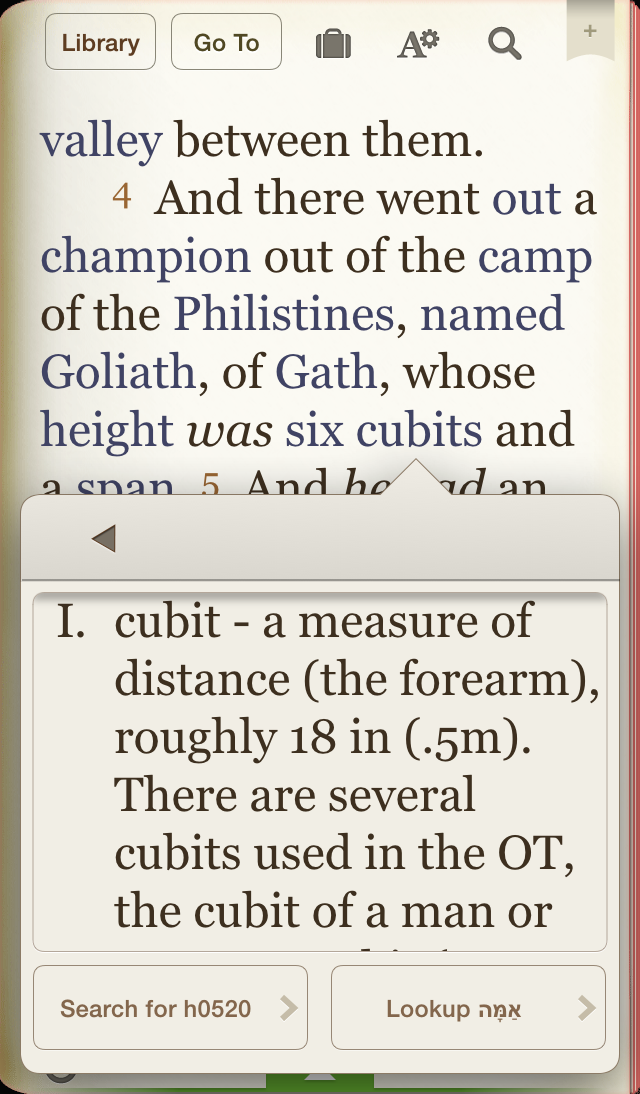
For only Og king of Bashan remained of the remnant of giants; behold, his bedstead was a bedstead of iron; is it not in Rabbath of the children of Ammon? nine cubits was the length thereof, and four cubits the breadth of it, after the cubit of a man.
 

13.5 ft. Long
6 ft. Wide
 
1 Samuel 17:4-9
And there went out a champion out of the camp of the Philistines, named Goliath, of Gath, whose height was six cubits and a span. And he had an helmet of brass upon his head, and he was armed with a coat of mail; and the weight of the coat was five thousand shekels of brass. And he had greaves of brass upon his legs, and a target of brass between his shoulders. And the staff of his spear was like a weaver's beam; and his spear's head weighed six hundred shekels of iron: and one bearing a shield went before him. And he stood and cried unto the armies of Israel, and said unto them, Why are ye come out to set your battle in array? am not I a Philistine, and ye servants to Saul? choose you a man for you, and let him come down to me. If he be able to fight with me, and to kill me, then will we be your servants: but if I prevail against him, and kill him, then shall ye be our servants, and serve us.
 

Goliath 9'6"


Joshua 14:14-15
Hebron therefore became the inheritance of Caleb the son of Jephunneh the Kenezite unto this day, because that he wholly followed the Lord God of Israel. And the name of Hebron before was Kirjatharba; which Arba was a great man among the Anakims. And the land had rest from war.
 
2 Samuel 21:15-17
Moreover the Philistines had yet war again with Israel; and David went down, and his servants with him, and fought against the Philistines: and David waxed faint. And Ishbibenob, which was of the sons of the giant, the weight of whose spear weighed three hundred shekels of brass in weight, he being girded with a new sword, thought to have slain David. But Abishai the son of Zeruiah succoured him, and smote the Philistine, and killed him. Then the men of David sware unto him, saying, Thou shalt go no more out with us to battle, that thou quench not the light of Israel.
 
2 Samuel 21:20-22
And there was yet a battle in Gath, where was a man of great stature, that had on every hand six fingers, and on every foot six toes, four and twenty in number; and he also was born to the giant. And when he defied Israel, Jonathan the son of Shimea the brother of David slew him. These four were born to the giant in Gath, and fell by the hand of David, and by the hand of his servants.
 
1 Chronicles 11:22-23
Benaiah the son of Jehoiada, the son of a valiant man of Kabzeel, who had done many acts; he slew two lionlike men of Moab: also he went down and slew a lion in a pit in a snowy day. And he slew an Egyptian, a man of great stature, five cubits high; and in the Egyptian's hand was a spear like a weaver's beam; and he went down to him with a staff, and plucked the spear out of the Egyptian's hand, and slew him with his own spear.
 

The Egyptian= 7'8"
 
Amos 2:9
Yet destroyed I the Amorite before them,whose height was like the height of the cedars,and he was strong as the oaks; yet I destroyed his fruit from above,and his roots from beneath.


Nephilim: TRUE STORY of Satan, Fallen Angels, Giants, Aliens, Hybrids, Elongated Skulls & Nephilim

By: Trey Smith


#11 Did Jesus Go to Hell? Part 1


Did Jesus Go to Hell?

Part 1

As a point of clarification, once this two part series is complete, you will realize that there has been a concerted effort by the enemy of God to corrupt God’s plan of redemption; therefore, the purpose of these two weeks is to give you a better overall understanding of the Bible and to remind that we are in a war!


Ephesians 4:8-10
Wherefore he saith, When he ascended up on high, he led captivity captive, and gave gifts unto men. (Now that he ascended, what is it but that he also descended first into the lower parts of the earth? He that descended is the same also that ascended up far above all heavens, that he might fill all things.)
 

In these verses, there are two main thoughts:
 
(1) There was a change that took place in the spiritual realm for the Old Testament saints. Previously, when they died, they went to a place of the departed souls where there was a waiting period for them before they could be brought to heaven. The terminology, ...led captivity captive...explains this thought, because the words captivity and captive are very similar in their origins and essentially mean exactly that. These Old Testament saints were captive in a location in the underworld because:
 
Hebrews 10:4
For it is not possible that the blood of bulls and of goats should take away sins.

 
The OT saints were held captive in this location because the plan for God's remission of sins had not been completed. But Jesus was the fulfillment of the sacrificial system, and His blood satisfied the just demands of God.
 
Now, in this Ephesians passage, what is taking place is the thought that these OT saints were captive and waiting, and now, with God's plan for sin being completed; they were released from this captivity and made captives of Christ where He brought them into the presence of God.
 
Now, that Jesus has completed the payment required for sin when a person dies, their eternal spirit departs to one of two places. If they're saved (In Christ), they're absent from the body and present with The Lord and their body awaits the day of its resurrection and glorification.
 
Most people are confused about the concept and terminology the Bible uses regarding the place we call hell, but let's try to bring some clarity.
 
There are several words used interchangeably to describe the place of departed souls. Regarding the Old Testament, there are words such as grave, death, Hades, but the main word we often think of is "hell," more specifically we are often associating these thoughts with eternal damnation, and how it's used in the New Testament when it's associated with eternal fire:
 
Through this story in Luke about the rich man and Lazarus, we learn that there are at least two different parts to "hell." And while there are two more concepts about Hell that we will need to delve into, we'll start here.
 
Luke 16:19-31
-- There was a certain rich man, which was clothed in purple and fine linen, and fared sumptuously every day: And there was a certain beggar named Lazarus, which was laid at his gate, full of sores, And desiring to be fed with the crumbs which fell from the rich man's table: moreover the dogs came and licked his sores. And it came to pass, that the beggar died, and was carried by the angels into Abraham's bosom: the rich man also died, and was buried; And in hell he lift up his eyes, being in torments, and seeth Abraham afar off, and Lazarus in his bosom. And he cried and said, Father Abraham, have mercy on me, and send Lazarus, that he may dip the tip of his finger in water, and cool my tongue; for I am tormented in this flame. But Abraham said, Son, remember that thou in thy lifetime receivedst thy good things, and likewise Lazarus evil things: but now he is comforted, and thou art tormented. And beside all this, between us and you there is a great gulf fixed: so that they which would pass from hence to you cannot; neither can they pass to us, that would come from thence. Then he said, I pray thee therefore, father, that thou wouldest send him to my father's house: For I have five brethren; that he may testify unto them, lest they also come into this place of torment. Abraham saith unto him, They have Moses and the prophets; let them hear them. And he said, Nay, father Abraham: but if one went unto them from the dead, they will repent. And he said unto him, If they hear not Moses and the prophets, neither will they be persuaded, though one rose from the dead.

 
Lazarus was in the place of departed souls known as Abraham's bosom. We would also believe that this is the place referred to as Paradise by Jesus when He spoke to the thief on the cross:
 
Luke 23:43
43 And Jesus said unto him, Verily I say unto thee, Today shalt thou be with me in paradise.
 

Abraham's bosom and Paradise was the place where the Old Testament saints who were followers of God departed until Jesus brought them with Him to glory.
 
Once Jesus died on the cross, and the debt of sin was paid in full, because the blood of the OT sacrifice couldn't remove the debt of sin: Hebrews 10:4

4 For it is not possible that the blood of bulls and of goats should take away sins.
 
Once again, Jesus at that point was able to lead captivity captive. In other words, He brought their departed souls to heaven, and there they await the resurrection of their bodies.
 
So in this first passage, we learn these truths:
 
(1) before the cross, the Old Testament saints, who were saved through faith in the sacrificial system, were kept in a place called Abraham's Bosom or Paradise until Jesus' blood accomplished what the blood of bulls and goats could not.
 
(2) the departed souls of people that were not believer's in God's way are in a place this story calls torments.
 
One other important concept that wasn't necessarily addressed in this story is that there is no more Abraham's Bosom, there is no Paradise, and there is no Purgatory! You make your decision for God today on this side of the grave. Once again to be absent from the body is to be present with The Lord.
 
Before we get into the last idea of hell, fire, and brimstone, we need to cover one more concept about the thought of hell.
 
1 Peter 3:19-20
By which also he went and preached unto the spirits in prison; Which sometime were disobedient, when once the longsuffering of God waited in the days of Noah, while the ark was a preparing, wherein few, that is, eight souls were saved by water.

 
Jude 1:6
And the angels which kept not their first estate, but left their own habitation, he hath reserved in everlasting chains under darkness unto the judgment of the great day.

 
2 Peter 2:4
For if God spared not the angels that sinned, but cast them down to hell, and delivered them into chains of darkness, to be reserved unto judgment;
 

It's my personal belief that all these passages have in common disobedient angels that are being held in chains in a prison known as "hell."
 
Now, the word hell in the original language has a meaning all its own. The word here is Tartarus. Because some of this is going to be such a new thought to some of you, I want to make sure that I do my best to explain.
 
The New Testament was written in a specific type of Greek. In times past, there were two types of Greek. One was known as Koine Greek, meaning common, and the other was known as Classic Greek. The New Testament was written in the Koine Greek. Now, it's important for us to understand that the Greek language was already in place before the New Testament writers wrote the New Testament. Therefore, these words were already in place and existed.
 
In some cases, the words kept the same meaning, but in other cases, when the New Testament writers used the words, the meaning changed. For instance, last week, when we talked about walking worthy, I told you about how the word lowliness was viewed by the Grecian culture as degrading and behavior only worthy of a slave. In contrast, the New Testament writers used it as an adjective to describe someone walking worthy of the title Christian.
 
In the case of this word Tartarus, this word was already in existence and had a specific meaning. Its meaning was connected to a place in the underworld, which imprisoned the gods who crossed lines and had sexual relationships with mortals and from there hybrid type heroes were birthed. One example would be Hercules.
 
So that is the name of this word Tartarus. I don't want to spend much more time on this tonight, but let us say that the connection between these three verses, the thought of chains, the thought of prison, and the thought of hell [Tartarus] all have a common link with these fallen angels.
 
So now we've learned about three different locations in hell. Abraham's bosom, which is gone now. torment, where unbelieving souls await the great white throne judgment, and Tartarus, which has some connection to chained up angels and a story about hybrids.
 
By the way, maybe we should mention the concept of Babel and why there are so many similarities across the globe regarding stories. For instance: flood stories, mother child deities, pyramids and ziggurats, which seem to be built the same in ancient times whether in Egypt, Babylon, or South America, and as we will discuss next week, this story about Tartarus.
 
My point is that there were certain things that were well known to the people who existed before the Tower of Babel where the languages were confused. God confused the languages for multiple reasons, but the main reason for our concern tonight was so that humanity would obey the command He gave Noah, which was to replenish the earth. Instead, what they had done was stayed together and rebelled against God.
 
As these people groups began their nomadic journeys across the globe, they all had eerily similar stories that the Bible explains all these people groups would have known, because they were things God had revealed to humanity before the languages were confused. Yes, the stories may vary slightly in some cases, but usually where they vary is when they depart from the truth of God's word.
 
So what story are we to believe. Well, God did a wonderful thing right after the confusion of the languages and the separation of the nations. He called a man named Abraham out from the nations, and He made a nation for Himself, and through this nation, He gave His word and He chronicled the real version of these occurrences, and all these other nations were worshiping false god, which are fallen angels and demon spirits. So God has told His story through His people Israel and the church, and that’s the truth.

 The last concept regarding hell is a place called Gehenna. It is also known as the lake of fire or the last death.
 
Matthew 10:28
And fear not them which kill the body, but are not able to kill the soul:but rather fear him which is able to destroy both soul and body in hell.

 
Mark 9:43-44
And if thy hand offend thee, cut it off:it is better for thee to enter into life maimed, than having two hands to go into hell, into the fire that never shall be quenched: Where their worm dieth not, and the fire is not quenched.

 
In both of these passages the word for hell in the Greek is Gehenna, speaking of the lake of fire, also known as the final judgment.
 
The word Gehenna comes from a real place that was on earth. This name comes from the valley of Hinnom, which was located south of Jerusalem. In ancient days, when Israel cheated on God by serving false gods, they made their children walk through the fire in this valley as they worshiped the false god known as Molech. Furthermore, during Jesus' time, it was used as a refuse place, where carcasses were burned along with other garbage.
 
With this in mind, you can now get a visual of what Jesus is talking about when He's teaching on hell. He's giving them a visual of what this place is going to look like.
 
Matthew 25:41
Then shall he say also unto them on the left hand, Depart from me, ye cursed, into everlasting fire, prepared for the devil and his angels:


Just to make a point, hell was never intended for human beings. God has always had a plan to save sinners. The purpose for hell was to judge Satan and his fallen angels.
 
Revelation 12:9
And the great dragon was cast out, that old serpent, called the Devil, and Satan, which deceiveth the whole world: he was cast out into the earth, and his angels were cast out with him.
 
Revelation 20:14
And death and hell were cast into the lake of fire. This is the second death.

 
So Gehenna is the place of final judgment.
 
But I don't want to leave you on a sad note because Hell doesn't await the child of God. The grave won't be able to hold the Christian down, because our Jesus was victorious. Jesus told Martha that He was the resurrection and the life. When we resurrect, we will receive a glorified body, and we will live eternally with our Lord.
 
2 Corinthians 5:6-8
Therefore we are always confident, knowing that, whilst we are at home in the body, we are absent from the Lord: (For we walk by faith, not by sight:) We are confident, I say, and willing rather to be absent from the body, and to be present with the Lord.
 
1 Corinthians 15:42-44
So also is the resurrection of the dead. It is sown in corruption; it is raised in incorruption: It is sown in dishonour; it is raised in glory: it is sown in weakness; it is raised in power: It is sown a natural body; it is raised a spiritual body. There is a natural body, and there is a spiritual body.
 
2 Corinthians 5:1-5
​ For we know that if our earthly house of this tabernacle were dissolved, we have a building of God, an house not made with hands, eternal in the heavens. For in this we groan, earnestly desiring to be clothed upon with our house which is from heaven: If so be that being clothed we
shall not be found naked. For we that are in this tabernacle do groan, being burdened: not for that we would be unclothed, but clothed upon, that mortality might be swallowed up of life. Now he that hath wrought us for the selfsame thing is God, who also hath given unto us the earnest of the Spirit.
 
1 John 3:2
Beloved, now are we the sons of God, and it doth not yet appear what we shall be: but we know that, when he shall appear, we shall be like him; for we shall see him as he is.
 

He has gone before as the firstborn from the dead:
 
Colossians 1:18
And he is the head of the body, the church: who is the beginning, the firstborn from the dead; that in all things he might have the preeminence.
 

He told Martha that He was the resurrection:
 
John 11:24-26
Martha saith unto him, I know that he shall rise again in the resurrection at the last day. Jesus said unto her, I am the resurrection, and the life: he that believeth in me, though he were dead, yet shall he live: And whosoever liveth and believeth in me shall never die. Believest thou this?

 
What does it mean that we will be as He is? Well, it doesn't mean that we will be gods. Instead, it's descriptive of His glorified body. In some way, our glorified body, will be like His after our resurrection from the dead.
 
What was His glorified body like?
 
John 20:19-20
Then the same day at evening, being the first day of the week, when the doors were shut where the disciples were assembled for fear of the Jews, came Jesus and stood in the midst, and saith unto them, Peace be unto you. And when he had so said, he shewed unto them his hands and his side. Then were the disciples glad, when they saw the Lord.
 

He still had the wounds of the cross! Also, notice the doors were shut and He appeared. In His glorified body, He operated above the laws of physical matter.
 
John 20:27-29
Then saith he to Thomas, Reach hither thy finger, and behold my hands; and reach hither thy hand, and thrust it into my side: and be not faithless, but believing. And Thomas answered and said unto him, My Lord and my God. Jesus saith unto him, Thomas, because thou hast seen me, thou hast believed: blessed are they that have not seen, and yet have believed.
 
Luke 24:39-42
Behold my hands and my feet, that it is I myself: handle me, and see; for a spirit hath not flesh and bones, as ye see me have. And when he had thus spoken, he shewed them his hands and his feet. And while they yet believed not for joy, and wondered, he said unto them, Have ye here any meat? And they gave him a piece of a broiled fish, and of an honeycomb.

 
He has bones and flesh, but there is no mention of blood. I can't prove this, but I believe the reason why is because, on earth, the life of the creature is in the blood, and in the resurrection, the life will be in the Spirit of God.


#10 Walking Worthy?

Walking Worthy?

 Review of Ephesians chapters 1-3, and continuing from chapter 4:1-6
 

Ephesians 1:3-4
Blessed be the God and Father of our Lord Jesus Christ, who hath blessed us with all spiritual blessings in heavenly places in Christ: According as he hath chosen us in him before the foundation of the world, that we should be holy and without blame before him in love:
 

V 3. The plan of God is that He would richly bless his creation with spiritual blessings. When speaking of spiritual blessings, the believer should imagine all the chaos and frustrations that this fallen earth offers. Then, from that place, it should be understood that God offers a healing from the curse of the fall; ultimately, all spiritual blessings find their source in the fact that humanity can have fellowship with the God of the universe.
 
However, it must be understood that those spiritual blessings can only be accessed in one place and that place is in Christ. Therefore, in verse three, the Holy Spirit, through the Apostle Paul, wants us to know that in the mind of God, this is all done. You are in Christ. He's in heaven, and as long as we remain in him, we remain in the will of God.
 
V 4. .… He has chosen "us" "in him"
 
"Chosen us"
 
Chosen is built from "EK" "LEKTOS"
Ek= out
Lektos= Chosen; this is where we get our word "election."
 
Now, the picking or choosing was predetermined at a time before Adam was even formed from clay in the potter's hand (1 Peter 1:19,20), and through this 1 Peter verse, we're given the revelation that it was the plan, Jesus Christ and Him crucified, not the individual person, which was foreordained or predetermined.
 
When the believer places his faith in Jesus Christ and Him crucified, there's a spiritual renovation that takes place inside the heart of that man. And in this place, the believer can be found holy and blameless, even allowed to be in the presence of God…holy and without blame before him in love.

 Ephesians 1:5
Having predestinated us unto the adoption of children by Jesus Christ to himself, according to the good pleasure of his will,
 

V 5. In this first, we received the first glimpse that God was creating an eternal family. The predestinated plan allowed us to be adopted and begotten as children into the family of God (I Peter 1:2,3).

 Ephesians 1:7
In whom we have redemption through his blood, the forgiveness of sins, according to the riches of his grace;


V 7. And all this took place through the redemption of his blood. We were purchased off the slavemarket of sin and translated from darkness to light (Colossians 1:13, 14).

 Ephesians 1:13-14
In whom ye also trusted, after that ye heard the word of truth, the gospel of your salvation: in whom also after that ye believed, ye were sealed with that holy Spirit of promise, Which is the earnest of our inheritance until the redemption of the purchased possession, unto the praise of his glory.


V 13–14. And when you heard the gospel and entrusted your life to the truth, you were sealed with the Holy Spirit of promise, which is the earnest or down payment. This is how you know you're saved. When the Holy Spirit comes to live in your heart a renovation takes place. The Holy Spirit doesn't leave the room the way it was before…things are going to change because grace is an inside job that's reflected outwardly in the life.

 Ephesians 1:16-18
Cease not to give thanks for you, making mention of you in my prayers; That the God of our Lord Jesus Christ, the Father of glory, may give unto you the spirit of wisdom and revelation in the knowledge of him: The eyes of your understanding being enlightened; that ye may know what is the hope of his calling, and what the riches of the glory of his inheritance in the saints,


 V 16, 17, 18. Paul's prayer was that God would give them a spirit of wisdom and revelation. He is asking God to allow their (Ephesian Christians and us) spiritual eyes to be enlightened, so that they could see three things:
 
(1) the hope of the calling – the Eliezer call.
 
(2) the riches of the inheritance in the Saints.
 
(3) The power given to believers

 Ephesians 1:21
Far above all principality, and power, and might, and dominion, and every name that is named, not only in this world, but also in that which is to come:


 V 21. The power that is given to believers in Christ is above and superior to the principalities and powers that reside in the heavenly realms [the forces of evil].

 Ephesians 2:1-3
And you hath he quickened, who were dead in trespasses and sins; Wherein in time past ye walked according to the course of this world, according to the prince of the power of the air, the spirit that now worketh in the children of disobedience: Among whom also we all had our conversation in times past in the lusts of our flesh, fulfilling the desires of the flesh and of the mind; and were by nature the children of wrath, even as others.


V 2:1,2,3. You will need this power because you live upon a world that is fallen and driven by the prince of the power of the air. You're in a war Christian, but you've been bought out of that system and placed on another path.


Chapters 2–3. A big thought that resounded throughout these chapters was the eternal family of God. Whether we utilize the terms: church, body, family, building, temple… The thought provoked is a community of believers, who have a common union, resulting in a common unity: faith in the sacrifice of the righteous one has brought us together in him, and we have become The holy habitation of God during this timeframe known as the church age.
 
Chapter 4. Now, there is a transition taking place from doctrinal instruction to practical Christian living.
 
Some people have accused me of being too spiritual, taking the position that a practical path towards preaching is better for today's Christian. The problem with this thinking is that, if the spiritual life of the believer isn't properly dealt with, where the "old" dies and the "new" is resurrected, or where the heart is regenerated, even a spiritual circumcision of its filth, then practical Christian living will be nothing but a failing and frustrating endeavor.

 Ephesians 4:1
I therefore, the prisoner of the Lord, beseech you that ye walk worthy of the vocation wherewith ye are called,


4:1. So the transition to practicality begins with the word "walk," which is really descriptive of one's behavior or daily Christian life. In other words, how you handle your business. "Can you talk to them about your Jesus after you did business with them?" Or did you "cut their ear off Peter?"

 Ephesians 4:2
With all lowliness and meekness, with longsuffering, forbearing one another in love;
 

4:2 in this verse, three adjectives describe how the believer's walk should look.
 
(1) [lowliness: humility]. This word was frowned upon in the Greek culture from which it originated. The description of humiliation associated with this word was used to describe the slaves of their society. However, the gospel turns around and teaches that when the "old man" born of Adam dies, the "new man" born in Christ takes upon himself the role of the slave (Philippians 2:6,7). Essentially, if you're going to be a real Christian, your "old man" and all his previous way of approaching this fallen world is going to have to die.
 
(2) [meekness: gentleness]. Often times, people mistake meekness for weakness. The Bible says that Moses was the meekest man on earth (numbers 12:3), but when Israel transgressed God (Exodus 32), he was enraged with righteous anger. Furthermore, even Jesus, who was the epitome of the meek and humble heart (Matthew 11:29) became enraged when He saw the moneychangers who were working in conjunction with the Pharisees and extorting the people.
 
• One other concept I would like to mention is that Paul made it clear that our unity (the people of God) is connected to our message (1Corinthians 1:10, 18). When leaders don't preach the gospel for the way it's written, the people are extorted spiritually and false doctrine results in their continued "worshiping" of false idols and sinning against God, simply because they're being deceived from the truth that liberates the soul. If this is happening to God's people, then there is going to be a lack of unity and if there is a prophetic voice in the house, a word of correction and righteous anger will be released.
 
(3) [long-suffering]. This word describes patience in relationships. We must always remember that we are all individuals and sometimes, we may get on each other's nerves; nevertheless, we are brothers and sisters in Christ. It should be noted that all these adjectives are fruits of the Spirit (Galatians 5:22, 23). Okay, so what's the significance with that? The significance with that is this: you can't manufacture this "stuff" through your flesh. This has to be done through a work of the Holy Spirit. The Holy Spirit does his work in the life of the believer through dispensing grace into the heart as the believer maintains faith in the finished work of Christ.

 Ephesians 4:3
Endeavouring to keep the unity of the Spirit in the bond of peace.

 
 4:3. The word endeavor describes labor or diligence. The mature believer works with diligence towards unity. Now, don't be confused and revert back to carnal Christian thinking: you can't change your heart and make it love when it's been wronged, but if you will allow the grace of God to circumcise your heart, then the fruit of the Spirit will be manifest in your life. From this perspective, you will be working in a spiritual sense, because you will know there are things in your heart that aren't right, and you will ask God to produce love, long-suffering, and peace through his grace.

 Ephesians 4:4-6
There is one body, and one Spirit, even as ye are called in one hope of your calling; One Lord, one faith, one baptism, One God and Father of all, who is above all, and through all, and in you all.
 

4:4, 5, 6. In the next three verses, there is a little bit of a transition that takes place, where the believer is reminded of the unifying example of the Godhead and the faith. Each member of the Trinity is mentioned while at the same time, the "oneness" or unity of God is emphasized as a reminder to the believer that the family of God is supposed to be one in purpose.
 
4:4. "One body and one Spirit" it's the Spirit of God that unifies and makes the people of God "one body" "in Christ."

4:5. "One Lord, one faith, one baptism "there's only one Lord and Savior and his name is Jesus Christ. And he alone is the entrance way into the one faith. We discussed this concept before, but in certain places the word faith is used as a noun rather than a verb. In this sense, the concept is "the faith." It is the place the Christian dwells, a translation into "the Christ," which places the Christian into "the faith."
 
Regarding the one baptism, some scholars seem to have disagreements: the question they banter over is whether this speaks of the baptizing of the believer into Christ by the person of the Holy Spirit (1 Corinthians 12:13), or the outward expression of this inner work, which is exhibited through water baptism. The main point I would like to clarify about this passage is this, it is faith in the sacrifice of the sinless one that allows the believer to be baptized or placed by the Holy Spirit into the person of Christ which now makes him righteous in the eyes of God. Water baptism is the outward physical sign of the inner spiritual work that has been completed in Christ. With that said, there is certainly truth connected to the fact that water baptism is the outward sign that a person is publicly professing their faith in Jesus Christ.
 
4:6. "One God and Father." God the Father is the authority of the Godhead. He resides in believers through the Spirit of God, which is made possible because of our position in Christ, which is made possible because of our "verb" faith placing us in the position of our noun "the faith."

#9 The Dwelling Place

Previously, we ended with the thought that God is not only preparing an eternal family, but He's also preparing an eternal dwelling place for His presence to be with His family. Presently, in this time frame known as the church age, God is preparing a bride, which is His body, who are individual lively stones, collectively being built as the temple of God where His presence will dwell upon this earth and reveal Himself to humanity until the consummation of this age.
 
Much of that thought is continued in the rest of this chapter. God desires to produce a place of habitation, so His presence can dwell with His people. He loves you, and He wants to live with you.
 
Ephesians 3:11 According to the eternal purpose which he purposed in Christ Jesus our Lord:
 

The eternal purpose reflects back to the verse we left last week, which explained the fact that God is revealing to both humanity and His angelic creation His multi-layered, multi-faceted, multi-colored wisdom through His church.
 
While mankind may be walking around with blinded eyes upon this earth, I can assure you that the angelic creation, both good and bad, is anticipating the next move by God. And currently, the wisdom of God is being made manifest in the fact that through the sacrifice and resurrection of Jesus, God has produced one family, more specifically, one "new man," a new creation in Christ.
 
Now, let's look a little closer at this first verse of tonight's study. The word purpose here has a lot of rich meaning with regards to the plan of God. The word purpose is used 12 times in the New Testament and is always either translated in English as the word purpose (as it is here) or shewbread. Now, we will continue the thought of the shewbread momentarily, but first, let's consider the meaning of the word itself, which is prosthesis. This is a compound word:
 
Pros- before or toward
Thesis- to show forth or put forth
 
With this in mind, if we continue the previous thought from last week, God desires to put forward or show forth the wisdom of His plan through the birthing of His people known as His church.
 
But let's consider the shewbread of the tabernacle, which we pointed out last week was a place God commanded Moses to build so that He His presence could dwell with His people (Exodus 25:8).
 
In this tabernacle, there was a golden table. Just the thought of a table carries with it the concept of communion or fellowship; for there are multiple references in the scriptures regarding the table of The Lord. More specifically, this table had lain upon it 12 loaves of bread. These loaves were situated in such a way that there were two stacks of six and upon each stack, there was a golden dish (vessel) where Frankincense was placed within and that vessel, which was filled with Frankincense, was placed upon the bread.
 
These loaves were called shewbread or the bread of presence, literally “the face” because they were to be placed continually before The Lord. In other words, the tabernacle is where God chose to dwell with His people and He wanted this bread in front of Him at all times. As we continue, we will see His reasoning is for communion, or worded differently, to dwell with His people.
 
Such care had to be taken with the exchanging of this bread, which was changed out on each Sabbath-- the day of God's rest. The procession of the changing would follow this pattern: eight priests were required in order to perform this solemn weekly ritual. In a fluid movement, two would remove the golden dishes containing the Frankincense, while two others removed the loaves and two others simultaneously replaced the loaves and two others simultaneously replaced the golden dishes with the Frankincense. There was never to be a moment within the tabernacle where these loaves were not before His presence (Numbers 4:7). Now, I have good news because God’s word tells us that Jesus is seated in the presence of the Father at His right hand, and (Ephesians 1:19; 2:6) tells us we’re in Him.
 
There is an extremely important spiritual principle in this: God desires for you to be in His presence. He has taken such meticulous moves to remain faithful to His plan through the millennia of preparing a place where His presence can dwell with His people. The good news is that Jesus is the fulfillment of those loaves; He never gets old or outdated and never has to be replaced, so you don't have to go one minute without His presence. As a matter of fact, I submit to you that if we find ourselves separated from His presence, it's not because He sent eight priests in to remove us; instead, we have removed ourselves.
 
After this task was completed, the priests were to eat the bread; whereas, a portion of the Frankincense was to be burned as an offering upon the fire. Fire is always symbolic of judgment and eating bread symbolic of communion. We can have Communion in the presence of God because of the fact that the sacrifice of Jesus took our judgment.


Regarding the Frankincense, there is much typology reflecting Jesus. First, the way it was harvested is reminiscent of the beating and sacrifice of our Lord; for Frankincense was a gum or resin extracted from a tree, which was accomplished by cutting deep incisions into the bark of the tree from which it came, resulting in the tree bleeding out a purely white resin. The name Frankincense literally means white, and this resin, which was burned upon the fire, represents the purity of Jesus. We are certainly not taking too much liberty when we connect Frankincense to our Lord; for the magi recognized the connection as they brought Frankincense (purity), Myrrh (used for embalming--death), and gold (royalty) and laid them at the feet of our Lord. In order to fulfill the Father’s will and assume His position as the King of Kings and the Lord of Lords, Jesus had to offer His purity as a sacrifice through death to purchase us from the dead.
 
The bread represented Christ. At the same time, the bread was 12 loaves representing Israel but stacked in two piles of six, which is the number of man. The presence of heaven's bread (John 6:35) perpetually in the face of God provides a place of communion for God's people and a hope of salvation for fallen man.
 
This brings us back to God's eternal purpose, which is to reveal Himself to His creation, through communion with His church, so that in this church age, a lost and dying world will see His plan and come to know His love.
 
Ephesians 3:12 In whom we have boldness and access with confidence by the faith of him.

 
There is no question in my mind that the Holy Spirit is calling us back to the book of Hebrews with the way this verse is worded. While we have covered this verse a lot lately, we must, because of the context, go back there one more time:
 
Hebrews 10:18-20 Now where remission of these is, there is no more offering for sin
 
[notice here the repetition with which the Law functioned: constantly sacrificing, constantly changing bread. Jesus' work is a finished work, so the repetition stops].
 
Having therefore, brethren, boldness to enter into the holiest by the blood of Jesus, By a new and living way, which he hath consecrated for us, through the veil, that is to say, his flesh;
 
Most specifically the thought "boldness" and "entering in" should be compared to boldness and access in our Ephesians passage. And all this should be considered in conjunction with the fact that God is holy and His place (tabernacle) is holy; nevertheless, He has a very methodical plan through which He wants to dwell in communion with man.
 
Ephesians 3:13 Wherefore I desire that ye faint not at my tribulations for you, which is your glory.
 
Paul encouraged the saints at Ephesus not to allow his shackles to cause them discouragement as though his situation was a symptom that God wasn't accomplishing His purposes. To the contrary, Paul was convinced that even in the midst of his own personal imprisonment God had called him to minister the gospel to the Gentiles, and it was imperative that they understand his (Paul's) afflictions were for their glory.
 
Just let that sink in for a moment Christian. Think about how you order your own life, making all your decisions based upon what you perceive to be best for yourself rather than what's best for the body of Christ. Part of the churches' problem is that we don't view ourselves as the building of God; instead, we want to remain individual lively stones, not considering how decisions may affect the larger body of Christ. You may not like this, but this way of thinking is selfishness. Would a person cut off a finger without thinking about how it would affect the overall body from that point forward? Of course not, so why do we allow ourselves to make individual decisions without regard for how it will affect the overall body of Christ? Because I submit to you that we can't see Jesus like Paul did.
 
Ephesians 3:14-15 For this cause I bow my knees unto the Father of our Lord Jesus Christ, Of whom the whole family in heaven and earth is named,
 
For the cause that God's purpose is being fulfilled in his life as a herald of the New Testament gospel, so the Gentile world will know the truth about Jesus, Paul bows his knees to the Father.
 
He bends the knee to the Father, and assumes a position of reverence in the presence of God. Even though he's in a jail cell for doing what God called him to do, he doesn't get bitter; instead, he reminds himself of how big the plan and purposes of God are, which he defines by going back to what all the previous thought alludes to: God is separating out for Himself a people for a family.
 
Ephesians 3:16-17 That he would grant you, according to the riches of his glory, to be strengthened with might by his Spirit in the inner man; That Christ may dwell in your hearts by faith; that ye, being rooted and grounded in love,
 

Strengthened- to be made strong_ (Strong's). Empowered to overcome resistance_ (Walvoord).
 
Might- comes from Dunamis, which is the miracle working power of God.
 
...strengthened with might by his Spirit in the inner man;...
 
This thought is still in reference to the family of God dwelling together as both Jew and Gentile are made as one. Most people would probably agree that there are very few things upon earth that cause more strife than racial divide. When the people of God, who are made up of all tongues, tribes, and nations are able to dwell together, it shows the men of the world and the angels in the heavenly realm the wisdom and power of God's plan.
 
But in order for God's plan to work on a corporate level, the Spirit of God must be allowed permission to change believers on an individual level. We've repeatedly made this point as we've journeyed through this series, but God's purposes in the church (His people) is to reveal Himself to the lost and dying. There is resistance to God's plan by the forces of evil, and one of the biggest ways the enemy combats God's plan is through causing God's people to behave in such a way that their testimony becomes invalid.
 
So God wants to strengthen. He wants to empower the believer through His power to resist the plans of darkness. And by His Spirit, empower the inner man of the believer.
 
The inner man here speaks specifically of the soul of man. We have covered this thought before, but it should be repeated. The inner man consists of both soul and spirit (Hebrews 4:12) and are the eternal aspects of our humanity; whereas, the physical aspect of our humanity is this temporal flesh in which our inner man is housed. Paul referred to this outward part as an earthen vessel that is fading in 2 Corinthians 4. But the good news is that as God changes our human frailties, the more His glory shines through these earthen vessels.
 
So the spirit and soul of man are the inner man and one day our external parts will be glorified. Regarding the inner man, the spirit is specifically that aspect to man that will never die; we are eternal beings; furthermore, the spirit of man is that part of him which connects with God:
 
John 4:23,2; Ezekiel 36:25-27
 
Until a man is born again, his spirit is dead to the things of God. This concept could be likened to a receiver implanted, allowing a connection between man and God to be made. In the Ezekiel passage, we are told that in the New Covenant there would be a change to our heart (which I believe in this text represents our soul-- emotion), a change to our spirit (God said He would put a new spirit in us) and lastly, He would put His Spirit in us.
 
Now, this concept goes perfectly with the thoughts that we've been discussing recently where the plan of God is to build a family, yes, but also a holy habitation for His presence to dwell. Once again, you are the temple of God and the Spirit of God dwells in you (1 Corinthians 3:16). So now you can become a walking worship service. Worship isn't something we do; instead, worship is our lives given back to Him. We certainly can express some of that through music, but what Jesus was referring to when He spoke to the Samaritan woman was that God's plan for true worship isn't about a place; instead, it's about His presence. And when He told her that salvation was of the Jews, He meant that from Israel, more specifically, Judah, He came. He came and brought salvation, which when embraced allows the spirit of man to be awakened to the things of God.
 
So our spirit is the eternal aspect of who we are. Both angels and humans are spiritual beings, but we live in houses of flesh. Furthermore, with our spirit, we connect to God (when born again), or we remain dead to God (when unredeemed/ non- believer).
 
While the spirit of man connects to God personally, the soul of man connects to his external environment. Through his soul, man filters and processes the external environment he engages on a daily basis. The word often translated for soul is psuche, where we get our English word psyche, which refers to the mind, thoughts, and emotions of man. Literally, the soul of a man refers to his individuality. In other words, it's your soul that makes you who you are. Matt is Matt. He's not Robert and vice versa. And with that thought the eternal aspect of your humanity I believe will be completely cognizant of what's happening for all eternity. In other words, of a person is in hell, they will know it, hear it, smell it, feel it....
 
It is through our soul that we perceive the world we live within. In other words our soul is the inner part that receives all the incoming information that we receive from our physical surroundings. Our soul receives the information of our external surroundings, and our flesh or physical body in turn engages our physical surroundings.
 
This certainly doesn't mean that our soul doesn't experience God. To the contrary, our soul experiences and perceives our external environment. Therefore, if our external environment is filled with things of God, then our soul is receiving and processing data regarding the things of God rather than the things of the world.
 
So the intake reflects the output. When the soul stays connected to God through faith in Jesus Christ and Him crucified, and our physical body follows suit, our hands pick up the Bible, our eyes behold the words of glory and our external filter is further filled with the things of God, and it just gets better: my mouth starts talking about Jesus, my hands start praising the Lord. My feet start walking to jail, not because I broke the law, but because I'm preaching Jesus.
 
And you could take this same scenario and apply it to multiple areas. But there is no doubt that these three aspects of our humanity are working in tandem with the free will that God gave man. If the soul is craving lust, it will use its physical members to feed its inner man lust and the result is that his spiritual connection to God becomes more distant. Whereas, the new man who craves the things of God, puts the environment of God within him, which feeds and strengthens the inner man.
 
Ephesians 3:17 That Christ may dwell in your hearts by faith; that ye, being rooted and grounded in love,
 

As the inner man is strengthened and changed, Christ, the anointed one is made to feel at home in our hearts. The word dwell describes reside, house, or live.
 
It's important that we understand that all this is made possible because of our connection point of faith in Jesus Christ and Him crucified. When I say it that way: Jesus Christ and Him crucified, I mean it that way! Because that is the way that God has chosen to covenant with man. As a matter of fact, Jesus Christ and Him crucified is God's covenant with man (Matthew 26:26-28). When Jesus says this is the blood of the New Testament, that's another way for Him to say, "The offering of my life is the sacrifice required of the New Covenant, and your connection to the Father, which is represented by this communion meal, is through faith in my sacrifice."
 
Why does our faith have to daily remain in His sacrifice in order for all this to work?
 
Romans 5:1-2 Therefore being justified by faith, we have peace with God through our Lord Jesus Christ: By whom also we have access by faith into this grace wherein we stand, and rejoice in hope of the glory of God.
 
First, let me remind you that we started down this trail because we're considering the concept of faith, because Ephesians 3:17 explains that it's by faith that Jesus is made to feel at home in the temple of our hearts.
 
But faith can be such an abstract thought. However I submit to you that in God's mind, it's not abstract at all. Instead, the Father has a specific plan that man is to connect to by taking his faith and keeping it there, and that plan is Jesus Christ and Him crucified.
 
Now, let's consider this thought more deeply. The Romans 5 passage says, "...being justified by faith..."
 
Well, first, what does it mean to be justified? It means to be declared righteous by God. You see, once again, God has a plan, and when man, places faith in God's plan (Jesus Christ and Him Crucified), that man is placed in Christ, receiving a new position of righteousness in Christ, which allows God to declare over that man's life a new verdict, "NOT GUILTY!" Furthermore, the not guilty verdict because of the gift of righteousness (Romans 5:17) allows the believer access into the grace of God.
 
In the presence of God, His grace changes things: the spirit of man is awakened to God, the soul of man begins craving what it was created for-- Jesus, and the physical body parts begin to connect to the godly resources that it's external environment has: church gatherings, study the scriptures, prayer, and practicing the presence of God. All this comes together, changing and strengthening the inner man to where Christ feels comfortable dwelling in our inner man.
 
Ultimately, this results in a process where a root system is formed and a settled foundation is established.
 

#8 Mystery Unveiled: Jesus the Communion

Matthew 13:1: parable of the sower intro to the thought of mystery, that which is hidden from the natural eye.
 
Ephesians 3:1-2
or this cause I Paul, the prisoner of Jesus Christ for you Gentiles, If ye have heard of the dispensation of the grace of God which is given me to you-ward:
 

For what cause Paul? For the cause of you Ephesian Gentiles, and you South Louisiana Gentiles who were strangers to the citizenry of God's kingdom. It's for your cause that Paul was a prisoner of Jesus.
 
This is the imprisonment in Rome where he was under house arrest, which was before the imprisonment where he was in a dungeon  in the ground in the Mamertine Prison, and from there eventually beheaded for his faith.
 
But in this imprisonment, he sits under house arrest for the cause of preaching the gospel to the Gentiles. Undoubtedly, there is a reference here also to the fact that the very reason he's in prison has something to do with his associations with one of the Ephesians named Trophimus (Acts 21).
 
But what really gets my attention is that no matter his circumstances, he remains focused on his real purpose in life. He calls himself a prisoner of Jesus. He's not a prisoner of Rome. Caesar doesn't hold the key to the chains that bind him to this spot, and he's also not second guessing whether he was in God's will bringing the gospel to these alienated Gentiles.
 
And then he continues by saying you have heard of the dispensation of the grace given to me for you right?
 
The word dispensation is a compound word connected to oikos, which is the Greek word for house. And the whole idea of the word is the thought of a house steward, and the way it relates to  Paul is that he has been entrusted with the task of bringing the gospel of Jesus to the Gentile world who doesn't know God, and the task can be likened to the thought of a house steward caring for his master's estate. Paul has been entrusted with a great responsibility, and he continuously forges forward with perseverance.
 
You're probably wondering in your mind, how does he do it? How does he carry on in spite of all the negative circumstances? How does he keep the faith and not just fall prey to depression?
 
The answer is "...the dispensation of the grace."
 
It's the grace of God that carries him through. No man, I don't care how resilient he may be, could carry the load Paul carried alone. It's the grace of God that bears the load in Paul's life as he accomplishes the will of God.
 
Grace changes the internal character of a man. Whatever he was before, look out because things are getting ready to change. If he was a quitter, now he's going to be a finisher with excellence. If he was weak as a father, he's about to become the best daddy a man could ever be...
 
You see grace is the supernatural working of the Holy Spirit strengthening a person to be what they couldn't be before on their own, strengthening them to do what they never could have done, it's the spiritual catalyst that changes everything. It's the hope when all hope has run out, it's the power when the bones are dried up and weakened. Just when all hope is lost and failure certain, grace shows up and takes over, and when that man allows grace to have its way-- watch out devil, because now that man or woman has become a force to be reckoned with in the hand of God.
 
Paul learned some things about grace before he ever sat under this house arrest (2 Corinthians 12:7-10). And let me say this to you Christian, "Whatever you do-- don't quit! Don't give up on Him, because He will never give up on you! Surrender your life to him, in your weakness, cry out to Him, and watch His grace change everything."
 
God gave Paul the supernatural strength he needed in order to accomplish the task he asked of Him, but let me say this Christian, "Grace must be submitted to in order for it to work; the head must be softened; the neck must be un-stiffened, and the knee must be bowed. If the man or woman of God refuses to let go of the reins and let God have His way, the wandering journey will continue when, instead, the power of God could be working on their behalf!
 
Ephesians 3:3-6
How that by revelation he made known unto me the mystery:(as I wrote afore in a few words, whereby, when ye read, ye may understand my knowledge in the mystery of Christ) Which in other ages was not made known unto the sons of men, as it is now revealed unto his holy apostles and prophets by the Spirit; That the Gentiles should be fellow heirs, and of the same body, and partakers of his promise in Christ by the gospel:

 
The word mystery is introduced in this verse and is the focal point of the thought surrounding the ten verses we will cover. Fourteen times in these six verses, from 3-10 of Ephesians chapter three, words like: mystery, knowledge, known, see, and understand are used.
 
Specifically, the mystery entails the fact that God's plan regarding the birth of His eternal family always included the entirety of the world, but that it was previously hidden in a mystery. A mystery is something that is difficult to see. It's a riddle that must be solved, a treasure that must be searched for, but in the case of God and His plans, a revelation that must be given by Him to man.
 
This mystery, Paul explains has been opened up to God's "holy" apostles. Maybe the word holy should receive attention, because I can assure you that religion, through the ages, has skewed our perception of the apostles. We have discussed this concept many times, but the word "holy" is hagios in the Greek and describes separated out ones. It's the same word that is often translated as sanctified, once again, meaning separated ones.
 
In the sense of sanctification, the believer is separated out from the world by being placed into Christ. In this place, the Holy Spirit indwells him, which separates the believer from the world. People may not like to hear this, but not everybody has the Spirit of God living in them. Only those born again from the dead are alive with the presence of God.
 
In the context surrounding this passage, the idea of the "holy" apostles is that they have been separated out by God for a purpose, to them the mystery of God has been revealed: God has an eternal plan, and this is what He meant when He said way back in Genesis:
 
Genesis 12:1-3 that in Abraham there was a blessing for all the nations.

The promise surrounded a nation that would come from Abraham, a nation that was in Him, and from him, a blessing for all nations would come forth and that blessing was Jesus. But heretofore the blessing was a mystery that is now being revealed.
 
So the word holy connected to the apostles surrounds a separating out for a purpose not some special level of Christianity they were given when compared to the rest of mankind, or some status attained that allows them to be depicted in religious art donned with crowns of halos.
 
As a matter of fact, these halos come from ancient Babylonian mystery religion; they represent the sun disc, which filtered from Babylon to Egypt and is found connected to Osiris and Isis in reference to the birth of their son Horus, which are all clues to Satan's agenda of usurping the power and plan of God.
 
I bring all this up because for so long I had this thought in my mind that these men were almost like gods; they were so holy, and how could their words help me, who was so unholy? No! You need to understand that you will never be separated out to do what they did (used as instruments to pen the holy writ), but your are just as holy in the eyes of God than they ever were because the same separation that made them holy made you holy; we were all made holy in the eyes of God when through faith, in the sacrifice of Jesus, we were translated from darkness to light, from the world into the place known as "In Christ."
 
Regarding Abraham:
 
Romans 4:16-22
Therefore it is of faith, that it might be by grace; to the end the promise might be sure to all the seed; not to that only which is of the law, but to that also which is of the faith of Abraham; who is the father of us all, (As it is written, I have made thee a father of many nations,) before him whom he believed, even God, who quickeneth the dead, and calleth those things which be not as though they were. Who against hope believed in hope, that he might become the father of many nations, according to that which was spoken, So shall thy seed be. And being not weak in faith, he considered not his own body now dead, when he was about an hundred years old, neither yet the deadness of Sara's womb: -- He staggered not at the promise of God through unbelief; but was strong in faith, giving glory to God; And being fully persuaded that, what he had promised, he was able also to perform. And therefore it was imputed to him for righteousness.
 
Ephesians 3:7-8
Whereof I was made a minister, according to the gift of the grace of God given unto me by the effectual working of his power. Unto me, who am less than the least of all saints, is this grace given, that I should preach among the Gentiles the unsearchable riches of Christ;
 

Minister is Diakonos, which means servant, literally, a table waiter. This is where we get the word deacon. I find this concept very interesting. This word was first used to describe Stephen and the other original deacons; their purpose was to minister practically through the physical distribution of food while the apostles sought the face of God and studied the scriptures (Acts 6).
 
But here, Paul applies this word to himself. He is a diakonos, a servant to distribute food to people. But in this sense, the thought is spiritual food, even the mysteries of God to inform them of their hope in Christ.
 
If his word is applied to you as a calling on your life, your response is not to be one of elevation of self. It's a lowering of self, a lowering where one is made to serve the master, and the master has asked His servants, "Feed my sheep!" Not, "Extort my sheep."
 
Paul self deprecates and debases his person outside of Christ...Unto me, who am less than the least of all saints..., but also makes it clear that grace has been given unto him to accomplish what God has called him to do. You see from the outside looking in with physical eyes it may seem that Paul isn't of God. He's in prison. I mean no one wants to take the time to consider why he's there, to consider the fact that he's in there for preaching the gospel and taking a stand against legalism.
 
Nowadays, they would say that Paul was out of the will of God because he didn't have enough faith and so he was thrown in jail. If The Lord tarries for any length of time, and the Christian who has Jesus burning in his heart lets him out you may go to jail too Christian.
 
I'm not talking about the majority of the church, which is sitting under a social gospel that wants to make the home life better and focuses on cleaning up the community. I'm talking about a gospel that focuses on allowing God to clean the heart! Those Christians that follow that gospel will be persecuted if the Lord tarries.
 
Paul's been given grace to preach the gospel. Jesus preached peace to those that were far off and those that were near. The good news of the kingdom must be heralded. There is a wedding taking place upon the horizon! You need to understand that God is looking for a bride to marry His Son. Will you marry the Son? How many people will have left their invitation in the envelope? How many people will have not even known because they weren't told.
 
I have thought many times about how the Apostle Paul was so against God, and then God performed a suddenly, where his life was transformed instantaneously before God, and suddenly there was such a flow of revelation given unto him.
 
Undoubtedly, he remains humble because forever burned on the retina of his mind are multiple occurrences where he led the way to rip people from their homes, having them placed in prison, having them killed; forever burned in his mind is the sight of Stephen being stoned, the sound of stone striking skin, then the crack of bone, the recording of these sounds undoubtedly from time to time played again in his mind. Then that glorious day when he was full of zeal on his way to Damascus, and he was overcome by the light of God. These are persistent reminders that outside of Christ he is nothing, but a hater of God's way, but in Christ, he has been given great revelation regarding the things of God.
 
In the words that the Holy Spirit would choose through Paul's vocabulary, "...I should preach among the Gentiles the unsearchable riches of Christ;"
 
Unsearchable- Untraceable: boundless: past finding out.
 
These riches, literally a treasure are past finding out but don't think for one moment that Paul has ceased in striving to mine for the gold that he knows is there.
 
What great treasures were revealed to this mighty man of God. All these connections where Jesus is the fulfillment of the Old Testament types:
 
He is the Passover lamb (1Corinthians 5:7)
He is the unleavened bread (1Corinthians 5:7)
 
He is the mercy seat where the blood is applied to settle God's offense against us (Romans 3:25: the word propitiation in the Greek is the same word for Mercy Seat)
He is the rock which when stricken living water flowed (1 Corinthians 10:4)
 
The grace of God was poured into this humble servant Paul so he, a diakonas, could serve us the bread of God by unveiling through the Holy Spirit the mystery of God.
 
Ephesians 3:9-10
And to make all men see what is the fellowship of the mystery, which from the beginning of the world hath been hid in God, who created all things by Jesus Christ: To the intent that now unto the principalities and powers in heavenly places might be known by the church the manifold wisdom of God,


God is using the church to reveal to both man and principalities (angels, both good and bad) the manifold wisdom of God. The word for manifold was used in ancient times to refer to embroidered patterns of many colors. The idea connects to beauty and diversity, but also unity in that all this is coming together as one. The church (called out ones) made up of both Jew and Gentile are a beautiful pattern of unity that has been woven together through the cross. And this being placed on display for both man and angel to see; for them to see the wisdom of God.
 
Mankind:

The purpose of Paul's stewardship was that all men would have the opportunity to have enlightened spiritual eyes. Remember Paul's prayer was that people would see with spiritual eyes. He wants all men to be able to see the mystery, which was previously hidden.
 
The word fellowship here in the Greek is literally koinonea and this word is also translated at times to the word communion.
 
Paul is continuing his thought from previous about people being able to see. He wants them to see this glorious mystery which was prepared from the beginning.
 
While we can attribute the word 'omniscience' to God and simply state that nothing takes God by surprise, if we consider the thought of this verse:
 
(1) God has a plan that he wants man to see
 
(2) God's eternal plan connects humanity together as a body or family for a common union or purpose; ultimately, it will result in eternal fellowship or intimacy, but what must be noted is the fact that this same verse mentions Jesus' role as the eternal word who spoke the worlds into existence.
 
This tells me that when the earth was created, God knew there would be a fall, resulting in a plan that was preordained (1 Peter 1:18) that would go into effect and through the ages He's been communicating the plan; really writing the story twice so humanity wouldn't miss it. Ultimately, whether we like it or not, the choice in the garden produced a daily choice for man. What will he choose? Who will he choose? God or what the spirit of the world is offering?


Angels:
But with regards to the principalities, there is something amazing taking place in the heavenly realms that you and I can't see. The angelic hosts both good and bad are viewing this redemption plan. And as God moves His plan forward, they are amazed and in awe at what God accomplishes. Everything seems scattered and thrown in different directions and then in Christ, God makes one new man. The church ekklesia, called out ones.
 
You have to understand that they've never experienced redemption. An angel will never be bought back from sin. All they know is that one third of their fellow creation went the way of Lucifer and now, those angels are destined for a lake of fire. And they see themselves and how grateful they must be that they didn't fall prey to the devices of God's most beautiful creation. How they must have previously looked upon his beauty and perceived in their angelic minds that this one was more special than they, and now they see how those that went his way are fallen and will never return.
 
But they also see that in man’s case, there is something altogether different going on in the spiritual realm. There is this thing called salvation, a buying back from the fall, and their angelic eyes observe everyday this glorious move of God!
 
Hebrews 2:14-17
Forasmuch then as the children are partakers of flesh and blood, he also himself likewise took part of the same; that through death he might destroy him that had the power of death, that is, the devil; And deliver them who through fear of death were all their lifetime subject to bondage. For verily he took not on him the nature of angels; but he took on him the seed of Abraham. Wherefore in all things it behoved him to be made like unto his brethren, that he might be a merciful and faithful high priest in things pertaining to God, to make reconciliation for the sins of the people.


Epi- above
Lambano- to seize or take hold of
 
God lowered Himself in order to seize, take hold of, or redeem humanity. He did not lower Himself to redeem fallen angels. He bypassed them. I can only imagine what they must have thought when they saw all this taking place in the spiritual realm
 
1 Peter 1:1-12
1 Peter Peter, an apostle of Jesus Christ, to the strangers scattered throughout Pontus, Galatia, Cappadocia, Asia, and Bithynia, Elect according to the foreknowledge of God the Father, through sanctification of the Spirit, unto obedience and sprinkling of the blood of Jesus Christ: Grace unto you, and peace, be multiplied. Blessed be the God and Father of our Lord Jesus Christ, which according to his abundant mercy hath begotten us again unto a lively hope by the resurrection of Jesus Christ from the dead, To an inheritance incorruptible, and undefiled, and that fadeth not away, reserved in heaven for you, Who are kept by the power of God through faith unto salvation ready to be revealed in the last time. Wherein ye greatly rejoice, though now for a season, if need be, ye are in heaviness through manifold temptations: That the trial of your faith, being much more precious than of gold that perisheth, though it be tried with fire, might be found unto praise and honour and glory at the appearing of Jesus Christ: Whom having not seen, ye love; in whom, though now ye see him not, yet believing, ye rejoice with joy unspeakable and full of glory: Receiving the end of your faith, even the salvation of your souls. Of which salvation the prophets have enquired and searched diligently, who prophesied of the grace that should come unto you: Searching what, or what manner of time the Spirit of Christ which was in them did signify, when it testified beforehand the sufferings of Christ, and the glory that should follow. Unto whom it was revealed, that not unto themselves, but unto us they did minister the things, which are now reported unto you by them that have preached the gospel unto you with the Holy Ghost sent down from heaven; which things the angels desire to look into.


"...desire to look into." Literally means to stoop over to look.
 
This thought implies a willingness to exert or inconvenience oneself to obtain a better perspective. The heavenly angels peer through the portals of heaven and observe the salvation of fallen man, and when a man is saved:
 
Luke 15:10
Likewise, I say unto you, there is joy in the presence of the angels of God over one sinner that repenteth.

 
And while all this is rejoicing over this mystery over salvation is taking place with the heavenly angels, I can only imagine the seething anger burning in the minds of the fallen ones:
 

Colossians 2:15
And having spoiled principalities and powers, he made a shew of them openly, triumphing over them in it.

 
 Because you see Jesus spoiled their plans, through the giving of His life, He paid sin's debt because the wages of sin is death (Romans 6:23) but the gift of God is eternal life in Christ Jesus. They didn't even know what was happening. They had a clue that one day something big would take place. They even knew that the serpent would be crushed by the seed, and that through the crushing somehow the seed would be hurt, but they were so thirsty for Jesus blood and death, they didn't even see that they played into God's plan all along, and the fact that their inciting Israel and Rome to hang Him on the cross signed the spiritual Emancipation Proclamation.

#7 From a Lost Stranger to a Lively Stone

Ephesians 2:11 Wherefore remember, that ye being in time past Gentiles in the flesh, who are called Uncircumcision by that which is called the Circumcision in the flesh made by hands;
 

Remember the past, the time when you were without Christ and were aliens from the life of God?  The Gentiles, in their uncircumcised state were separated, and outside covenant with God;
 

Ephesians 2:12 That at that time ye were without Christ, being aliens from the commonwealth of Israel, and strangers from the covenants of promise, having no hope, and without God in the world:
 

The word Christ is the Greek language's version of the concept of "The Anointed One," and Messiah is the Hebrew version of the same thought, The Anointed One.
 
Who is The Anointed One? He is the one who was foretold and prophesied of from the times of old. He's the one who would crush the serpent's head in the garden. He's the seed promised through the ages of God. He's the lion of the tribe of Judah to whom the scepter of Shiloh belongs. He's the blood painted on the doorpost that fateful night in Egypt. He's the red or scarlet thread blowing in the wind as it hangs from Rahab's window signaling that there is one in this wicked town that believes the God of Israel will deliver. He's the one who was pierced in Psalm 22. He's the one who bore our transgressions and iniquities in Isaiah 53. And He's so much more than my little mind could ever conceive. He's Messiah, the Christ, the anointed one, and He's come to bring us the life of God.
 
But let's stay close to the text. We're dealing with the circumcision (Jewish people and their covenant with God) versus the uncircumcision (Gentiles who were without God or a covenant).
 
The Gentiles had no way of knowing the life of God. They were under the bondage of pagan idolatry, being driven through human history by fallen angels and demon spirits. Living according to the course of the world, spending their little vapor of life indulging their fleshly appetites, and thinking they were really living.
 
The Gentiles had no way of knowing that there was another way of life because they were under the control of taskmasters. The book of Daniel teaches us that there are spiritual entities that control regions of this physical world. In Daniel (Daniel 10:13,20), we're informed of the fact that there was a prince of Persia hindering Daniel's prayers. The archangel Michael had to come to the assistance of, who was probably, the angel Gabriel to combat Persia's prince. At the time of this Daniel passage, Israel was in captivity to the Medo-Persia Empire. Babylon had already been toppled by this current Empire just mentioned. The reference to the Prince of Persia shows us that there is more than meets the eye; there is conflict in the spiritual realm that is physically manifested in the spiritual realm. The prince of Persia is a fallen angel that is hindering the work of God, and Michael the archangel of Israel is dispatched to help; furthermore, we are told that there will soon be conflict with the prince of Greece. This is in reference to the fact that Greece would eventually conquer Medo-Persia, and Israel would then be under Greece’s captivity until the Roman Empire. Essentially, the point I wanted to make is that there are spiritual strongholds that have power over the spiritual realm, and they specifically rule over the Gentile nations, and are constantly trying to cause confusion to the kingdom of God.


In addition, these princes represent those principalities, powers, mights, and dominions that Paul mentioned in the early part of Ephesians chapter two, when he was explaining that "In Christ," those who believe, the ones in "the faith," have been given power over these principalities and powers.
 
At least the Jewish people understood these concepts. Now, you have to understand that at the time Paul writes this letter, the Jewish people as a nation aren't in covenant with God; instead, they've rejected Messiah. That doesn't mean that God is done with national Israel. Replacement theology is a lie that says the church has taken the place of national Israel. No! God isn't done with them as a nation, but in the meantime, only those that are saved through the blood of the Lamb are in covenant with Him.
 
But continuing the thought, it's important to note that it was to Israel that the promises were made. God called Abraham and promised him a place and a people through which Messiah would come. Isaac shall his name be called, who was father of Jacob, whose name change to Israel was given to his twelve sons, who were the twelve tribes, who became the nation known by the same name as they exited or made the Exodus on that fateful Passover night, and it was to this people group that all those prophesies and promises were made in reference to the manifestation of the anointed one, and then He came.
 
The Word became flesh and dwelt among us, (and we beheld His glory as of the only begotten of the Father,) full of grace and truth (John 1:14).
 

Just reflect on all that for a moment: the promise was manifest, the promise was Jesus, and now, we, like John, have beheld His glory-- at least spiritually for us.
 
But once again all this forewarning, foreknowledge, and promises were given to Israel. The Word of the living God was given to Israel.
 
Romans 3:1-2 What advantage then hath the Jew? or what profit is there of circumcision? Much every way: chiefly, because that unto them were committed the oracles of God.
 
Not only was Israel entrusted with the oracles of God, but they were given the covenant promises:
 
Abrahamic Covenant: a seed will bless all nations (Genesis 12:3): that seed is Christ (Galatians 3:16).
 
 Davidic Covenant: an eternal king will be given (2 Samuel 7:13).
 
Mosaic Covenant: Old Testament with all its sacrifices, the tabernacle, and so many other rich expressions foreshadowing the coming of Jesus.
 
New Covenant: promises were given to Israel, and we are simply beneficiaries of their promises through faith: (Ezekiel 36:25-27; Jeremiah 31:31).
 
Israel as a nation was created by God with great purposes. She would serve as the womb from which Messiah would be birthed if permission to speak this way is granted; furthermore, she was entrusted with the very words of God. While all other nations may have flood stories containing some truth, only Israel has a flood story containing the truth. And to this people that He birthed through the loins of Abraham, He ultimately gave Messiah, but He also gave His eternal truth, to Israel, to them, He entrusted the oracles of life, and as much as Satan has tried to destroy the Word of God in an attempt to make the minds of humanity forget His existence, the Bible still stands. It stands strong and says, "Contained within the covers of this book there is power."
 
Preach the power of God preacher! Why do you trifle and meddle with strange fire? Why do you teach as commandments the doctrines of men? Why do you allow the gospel to be diluted in an attempt to make the masses happy?
 
Ephesians 2:13 But now in Christ Jesus ye who sometimes were far off are made nigh by the blood of Christ.

 
But God changed all that for humanity; whereas, we were previously far away, we've been brought near through the blood of Jesus. The sin of Adam and our own "ante into the game" had left us in the most uncomfortable place of separation. As the Gentiles in the text, we too were without the life of God, but now we aren't. Hallelujah! And our children don't have to be. They will have to make their own choices to serve Him, but if we will, at least they will have been given that choice and chance, at least they won't be like the wandering Gentile without any knowledge of God in the midst of this godless society that keeps traveling in the wrong direction.
 
Ephesians 2:14,15 For he is our peace, who hath made both one, and hath broken down the middle wall of partition between us; Having abolished in his flesh the enmity, even the law of commandments contained in ordinances; for to make in himself of twain one new man, so making peace;
 

As previously noted, there were two types of people on the earth before Messiah's manifestation. The first of the people groups are the Jews, the nation God created for Himself, and the second of the people groups are the Gentiles, those who were unaware of the one true God. Verse 14 explains that Jesus is the peace between the parties because He has removed the barrier that separated the two groups when He made one man in Christ.
 
The wall acting as a barrier has been postulated as many things such as the wall separating the Gentile court from the rest of the temple. While it is true that this wall existed, the context here doesn't mention the actual temple. However, circumcision has been mentioned, which was a separating and distinguishing factor between the two people groups. And the circumcision really represents the Law, which certainly was a dividing wall.
 
The Law as righteousness was annulled when Messiah was manifest in the flesh, because Jesus was the physical manifestation of God's righteousness, He was the fulfillment of the plan!
 
Romans 3:21-22 But now the righteousness of God [Jesus] without the law is manifested, being witnessed by the law and the prophets; Even the righteousness of God which is by faith of Jesus Christ unto all and upon all them that believe: for there is no difference
 
And to be truthful, the Law wasn't on Israel's side either because they didn't keep it; therefore, it called them guilty, but according to Colossians 2:15, the enmity (againstness) that was between us because of the Law was removed when Jesus nailed it to His cross, so quit living in the past Christian. You're not guilty if you're in Christ.
 
The word peace describes harmony and, and through the cross, the plan of God was completed for righteousness; therefore, there is no longer Jew and Gentile in the mind of God. The Jew may still look down upon what he calls the uncircumcised, but he is an unredeemed Pharisee full of hypocrisy and relative righteousness if he does.
 
Those who are redeemed in Christ are the people of God:
 
1 Peter 2:6-12 Wherefore also it is contained in the scripture, Behold, I lay in Sion a chief corner stone, elect, precious: and he that believeth on him shall not be confounded. Unto you therefore which believe he is precious: but unto them which be disobedient, the stone which the builders disallowed, the same is made the head of the corner, And a stone of stumbling, and a rock of offence, even to them which stumble at the word, being disobedient: whereunto also they were appointed. But ye are a chosen generation, a royal priesthood, an holy nation, a peculiar people; that ye should shew forth the praises of him who hath called you out of darkness into his marvellous light: Which in time past were not a people, but are now the people of God: which had not obtained mercy, but now have obtained mercy. Dearly beloved, I beseech you as strangers and pilgrims, abstain from fleshly lusts, which war against the soul; Having your conversation honest among the Gentiles: that, whereas they speak against you as evildoers, they may by your good works, which they shall behold, glorify God in the day of visitation.


Ephesians 2:16 And that he might reconcile both unto God in one body by the cross, having slain the enmity thereby:
 

The word slain literally means to outright put to death, and the word enmity describes hatred, opposition, or let me make up a word "againstness." There was "againstness" between Jew and Gentile because the Law stood between the two.
 
Ephesians 2:17 And came and preached peace to you which were afar off, and to them that were nigh.
 

So Jesus' righteousness offered as payment for sin removed the dividing wall of Law for righteousness that separated Jew from Gentile, resulting in a whole new race of man being created, and that new man has a name. Today, we call him Christian, and he lives in a certain place, which we call "in Christ."
 
Now, a new concept is considered because the "againstness" here doesn't just refer to an enmity between Jew and Gentile; rather, the enmity in this verse refers to the "againstness" existing between God and man, whether that man is Jew or Gentile.
 
Jesus' cross fulfilled righteousness:
 
For Christ is the end of the law for righteousness to every one that believeth. Romans 10:4

 
And because the manifestation of Messiah has come, the vessel was changed from water to wine, the sacrificial system was fulfilled, Jesus sat down, and the Jew can't live for God according to the old way anymore; instead, he must come the way of the cross, or he won't come at all.
 
And this is the meaning to this thought...preached peace to you which were afar off, and to them that were nigh.
 

Preached is Euaggelion, which is where we get our word, evangelize. There are other words that are translated as preach, but have different meanings in the Greek; for instance, the word kerusso means proclamation, and while it can be used to describe a proclamation of the gospel, it usually describes a legal pronouncement.
 
The preacher in this verse...he preached...is referring to Jesus. He proclaimed the New Covenant message that would bring peace between God and man, and it's the same message for both those that were far away (Gentiles) and those that were near (Jews), but don't be confused by the modern gospel. The peace was made through the blood of His cross:
 
And, having made peace through the blood of his cross, by him to reconcile all things unto himself; by him, I say, whether they be things in earth, or things in heaven.
 
Ephesians 2:18 For through him we both have access by one Spirit unto the Father.

 
The Greek scholar Kenneth Wuest explains this word access by describing a liaison providing availability to a national leader. He also states that the French word entree' is a perfect word to describe the thought-- permission is granted, you may now see the king.
 
Jesus opened the door for access through the cross, and the Holy Spirit brings us into God's presence, which is the presence of the Father, so we are painted a picture of the trinity in this verse.
 
Ephesians 2:19-22 Now therefore ye are no more strangers and foreigners, but fellowcitizens with the saints, and of the household of God; And are built upon the foundation of the apostles and prophets, Jesus Christ himself being the chief corner stone; In whom all the building fitly framed together groweth unto an holy temple in the Lord: In whom ye also are builded together for an habitation of God through the Spirit.
 
Ephesians 2:19
Now therefore ye are no more strangers and foreigners, but fellowcitizens with the saints, and of the household of God;
 

Through faith in God's redemptive plan, the former foreigner, a Gentile has been grafted into the family of God (Romans 11:17-19), and has become part of the family of God.
 
Faith in God's eternal plan, causes the "old man" who was wandering aimlessly without hope, separated from the life of God to die, and the "new man" is resurrected into a new place called "In Christ," and "In Christ," the "new man" has become partaker of God's nature (2 Peter 1:4), which has changed his "pedigree"-- he's now been born again as a child of God, a new citizen of God's kingdom, a new child in God's family, a new resident member in the household of God.
 
It's not typical behavior that we just let anyone come live in our home. While many of us may have opened our doors to strangers for a night or two, sometimes even weeks or months, typically, the home is a place denoting intimate fellowship. You're of the household of God Christian, and God wants to have intimate fellowship with you.
 
Ephesians 2:20 And are built upon the foundation of the apostles and prophets, Jesus Christ himself being the chief corner stone;
 
There is a progressive thought being built in these last verses of this chapter. The people of God, who consist of both Jew and Gentile created in Christ are now one man in Him. And this "new man" exists in the household of God, but as we will soon see, the "new man" isn't just a partaker in the household of God; rather, he is literally part of the building itself.
 
The word for foundation in verse 19 can be used to describe the concept of both something’s beginnings, and  it can also be used to describe the substructure of an architectural endeavor. In this verse, the word foundation is being used both ways. In somewhat of a metaphorical sense, there is a building being constructed, which will house the presence of God, and the foundation of that building consists of the work of Jesus (the cornerstone) and the disciples (the finishers of the foundation).
 
As we've already explained over the last couple weeks, Jesus was given by God to lost and dying humanity, who were stumbling separate from God in the dark. Jesus accomplished the work of the Father on the cross opening the door for humanity to gain access to the presence of God. And the disciples continued the work, which was entrusted into their hands. What an amazing thought of how real God is that we're still considering this today. Review Jesus' prayer again in John 17 where He prays to the Father about helping the disciples as they've been chosen to continue the work. Jesus and the disciples have laid a foundation for the work, the house, the dwelling place of God.
 
We should not move past the truth that Jesus is the Cornerstone, which could also be thought of as the first foundational stone to be laid before the structure can be built.
 
1 Peter 2:4-8 To whom coming, as unto a living stone, disallowed indeed of men, but chosen of God, and precious, Ye also, as lively stones, are built up a spiritual house, an holy priesthood, to offer up spiritual sacrifices, acceptable to God by Jesus Christ. Wherefore also it is contained in the scripture, Behold, I lay in Sion a chief corner stone, elect, precious: and he that believeth on him shall not be confounded. Unto you therefore which believe he is precious: but unto them which be disobedient, the stone which the builders disallowed, the same is made the head of the corner, And a stone of stumbling, and a rock of offence, even to them which stumble at the word, being disobedient: whereunto also they were appointed.
 
Ephesians 2:21 In whom all the building fitly framed together groweth unto an holy temple in the Lord:

 
Once again, we see a form of that prepositional phrase we have spoken of in the past. In this case, it's worded as "In whom," but the whom is Christ, so in this place the believer (new man) is one aspect or part of an architectural building. The thought in the original language regarding the word "building" is an architectural structure; furthermore, the phrase, "...fitly framed together...," describes a joining, compacting, or union. If you could imagine a welding machine or a rivet gun connecting metal beams as a structure is being joined together for a purpose, you could imagine in your mind a "building" being erected for God's habitation upon this earth.
 
However, in this analogy, the connection or common union isn't a rivet or weld; instead, the common union is our connection in Christ, which came through our faith in His sacrifice killing the old, creating the new, and making us all part of one body in Christ.
 
Ephesians 2:22 In whom ye also are builded together for an habitation of God through the Spirit.
 
So the corporate body of Christ is made up of individual believers, in which God's presence dwells upon this earth. The word habitation literally means dwelling place. In us, through us, the presence of the Holy Spirit dwells upon this earth moving and operating in the hearts of humanity, moving and operating upon the hearts of those who are still strangers and foreigners and without citizenship.
 
In closing, I would like to consider the progressive concept of God's dwelling. Before the fall, God's presence dwelled with Adam and Eve, but since the fall, a large part of God's eternal plan has been to bring His presence back to His lost wandering creation. In the creation of His own nation Israel, a big step in bringing His presence closer was the building of the sanctuary.
 
Exodus 25:8 And let them make me a sanctuary; that I may dwell among them.
 If we take some time to study the Tabernacle, we realize that this tent not only foreshadows the coming of Jesus, but it provided a dwelling place to house the presence of God. As mentioned last week, there were two chambers to the tabernacle. The first was the holy place, which contained the table of shewbread, also known as the bread of presence, which represents Jesus because He is the presence of God manifested to humanity in physical form.
 
Then in the middle before the veil was the altar of incense. A coal from the bronze altar, which was located in the front of the tabernacle on the outside, was placed on the altar of incense, also known as the golden altar. The bronze altar outside was where the sacrifice was offered to God, and a coal from the sacrifices remains was the only source of ignition allowed by God to burn the incense. The purpose of the incense was to provide intercession or a shrouding protection between the high priest and God when he entered through the veil into the holiest of holies. Jesus is our sacrifice, but He is also our intercession. His presence stands between us and the holiness of God protecting us, providing intercession for us.
 
To the left was the menorah or the lamp stand. The lamp stand provided light for work. It consisted of six branches connected to one middle branch all containing oil (Holy Spirit) providing light. Interesting to me is the fact that six is the number of man and seven is the number of completeness with God. Until man (the six outer branches) are connected to Christ (the middle and seventh branch) man is incomplete; furthermore, He is the light of the world, but as He taught in Matthew 5, in Him, we become the light of the world as we reflect His glory.
 
But the main point I wanted to make was the fact that God promised His presence would dwell in the inner sanctuary, also known as the Holy of Holies:
 
Exodus 25:18-22 And thou shalt make two cherubims of gold, of beaten work shalt thou make them, in the two ends of the mercy seat. And make one cherub on the one end, and the other cherub on the other end: even of the mercy seat shall ye make the cherubims on the two ends thereof. And the cherubims shall stretch forth their wings on high, covering the mercy seat with their wings, and their faces shall look one to another; toward the mercy seat shall the faces of the cherubims be. And thou shalt put the mercy seat above upon the ark; and in the ark thou shalt put the testimony that I shall give thee. And there I will meet with thee, and I will commune with thee from above the mercy seat, from between the two cherubims which are upon the ark of the testimony, of all things which I will give thee in commandment unto the children of Israel.
 

But all these were types and shadows painting a picture that one day fulfillment was on the way, and that fulfillment came in Christ:
 
John 1:14 And the Word was made flesh, and dwelt among us, (and we beheld his glory, the glory as of the only begotten of the Father,) full of grace and truth.
 
The word dwelled here literally means to tabernacle or sanctuary. So we see a clear progression in the word of God where He is bringing His presence back to man. And now, in the Ephesians passage, we are told that the body of believers who are connected in communion with Christ through faith in His sacrifice, have become the dwelling place of God.


#6 When God Transplants the Heart, Reviving and Remolding Will Start

As I was thinking about this title, which I felt like communicated the essence of this passage; I was reminded of an occurrence that happened when I was working in ICU. I worked on a unit where we took care of open heart surgery patients.
 
Now, these patients weren't transplants, but they needed bypass grafts to restore blood flow (life) to their heart; without that change to their hearts, they couldn't live.
 
There was one occurrence when I was working a night shift and a man who had had surgery that day went into V-fib, it's a heart rhythm that's not compatible to life because the heart isn't beating; instead, it's in a state of a weak quiver, and there is no real movement of blood, no real life circulating; sadly, this is where many Christians live, in a state of spiritual V- fib.
 
Anyway, we were frantically doing CPR, getting ready to shock the patient when the surgeon walked in to the room and said get the thoracotomy tray because we're going to have to open him up.
 
I can still remember her telling me, “Take those hemostats and rip those staples out!” And like unzipping a zipper, I ripped those hemostats through the staples, as they flew in all directions in the air, the skin covering his sternum opened, revealing the wires holding together.
 
"Come on Matt! Get the wire cutters and cut those wires! Hurry," so I did.
 
"Come on Matt! Get those retractors and open that chest up." I can still remember opening his chest and seeing that big quivering heart he had, it was barely hanging on for life.
 
"Grab it!" She said. "Grab it and start squeezing," so I squeezed, and then we shocked with internal paddles, and I squeezed and then we shocked...on and on, we feverishly worked to bring life back to this Man's quivering heart.
 
Unfortunately, he didn't make it through that trial in his life, and I don't know where he was spiritually at that moment, but I wanted to use that as an illustration to speak about the spiritual heart of man.
 
In his fallen state, man's heart (his spirit/ the part that connects to the life of God) is quivering at best, there is no life flowing through it. But God's plan has always been to offer hope through a heart transplant.
 
In the Old Testament, promised that there would be a day when He would do something different than ever before. He was talking about the New Covenant, a new agreement, where He would meet man according to His plan.
 
In this New Covenant, God said:
 
Ezekiel 36:25-27
Then will I sprinkle clean water upon you, and ye shall be clean: from all your filthiness, and from all your idols, will I cleanse you. A new heart also will I give you, and a new spirit will I put within you: and I will take away the stony heart out of your flesh, and I will give you an heart of flesh. And I will put my spirit within you, and cause you to walk in my statutes, and ye shall keep my judgments, and do them.

 
In this New Covenant, the promise was a heart change. God's plan would no longer work according to external religion; instead, He was saying that there would come a day when He would do an inner work, changing the very interior of man, that part of him which was driving his outward actions.
 
When God changes the heart, the reviving and remolding will start!
 
He also spoke through the prophet Jeremiah saying:
 
Jeremiah 31:31-33
Behold, the days come, saith the Lord,that I will make a new covenant with the house of Israel, and with the house of Judah: Not according to the covenant that I made with their fathers in the day that I took them by the hand to bring them out of the land of Egypt;which my covenant they brake,although I was an husband unto them, saith the Lord: But this shall be the covenant that I will make with the house of Israel;After those days, saith the Lord,I will put my law in their inward parts,and write it in their hearts;and will be their God,and they shall be my people.

 
In this New Covenant, the internal miracle would result in God's Law being placed within the heart of the person. When the heart is "transplanted" by God, His Law or character (His Word/ who He is) is planted within the interior of man.
 
How does this happen? Because when a man or woman is born again, the Holy Spirit of God, the very life of God, and the author of the Law of God, now lives in the heart of man. So long before the sin is committed, the Holy Spirit is convicting, instructing, pleading with the believer not to transgress God's word.
 
Lastly, before we start, it's important that we understand the role of the Word and the Spirit in all this. God's word is His communication to this lost and dying world. Fallen humanity's thoughts are far removed from God; therefore, God sent His language to earth in the form of His word.
 
As the believer, begins to place God's word in him, the Holy Spirit that now lives in the transplanted heart begins to transform the whole view of reality. In this scenario, the transplant has been effective, blood flow has been restored, and the life of God is transforming the mind and conforming, even molding the believer into the image of Christ.


When God Transplants the Heart, the Reviving and Remolding will Start

Ephesians 2:3
Among whom also we all had our conversation in times past in the lusts of our flesh, fulfilling the desires of the flesh and of the mind; and were by nature the children of wrath, even as others.


…by nature the children of wrath, even as others.
 
The word children here is specifically related to the process of birth, or the production of offspring, and these children are described as those that by reason of their inherent nature were children facing wrath. Furthermore, earlier in the verse, Paul explains to the Ephesians that they also used to be among these ranks.

Sinful Nature

When God created Adam, He created him in His image and likeness Genesis 1:26,and Eve was brought forth from the side of that image, but since the occurrence of the fall, the procreation of man has followed a replication pattern of Adam's fallen image instead of the original state where Adam was created in the image of God, the image given him when he was formed of the dust and God's life was breathed within His lungs. Genesis 5:3.
 
Romans 5:12 teaches that the effects of Adam's sin has spread through the entirety of the human race.
 
Interestingly, along the "sinful nature" thought line, in the book of Romans starting at the end of chapter 5 through all of Romans 6, the word sin is used 19 times, but only once in all those places is the word used as a verb. Every other time, it's being used as a noun, which describes a person, place or thing, and in this case the noun is describing the nature of sin we received from our father Adam in our first birth.
 
Another way to describe this thought is that the sin nature (noun) is the root of sin and the (verbs/ actions) of sin are simply the fruit of the root. In essence, we need a miracle from God at the root system, because this alone will change the fruit that's manifested in the life, at least for the believer who is willing to allow the Holy Spirit to have His way.


I put this thought in the notes a couple weeks ago, and while I don’t intend to be redundant, as I was originally writing this idea, I believe God was giving me a revelation that I had previously not had. Just as Eve, Adam’s bride, was brought forth in a pristine state without spot or wrinkle from Adam’s sinless side, the bride of Christ has been grafted and is being re-created in Him, progressively being conformed into the image of our Lord until that glorious day when we will see Him (1 John 3:2), and then we will be as He is; we will have a sinless glorified body, and we will be restored to a state that truly reflects the image of God.


Ephesians 2:4, 5
But God, who is rich in mercy, for his great love wherewith he loved us, Even when we were dead in sins, hath quickened us together with Christ, (by grace ye are saved;)

 
We were dead in sins, which ultimately refers to being dead to the life of God, a separation from His presence. Sin in Adam and Eve's life resulted in expulsion from the garden, separating them from the presence and life of God (Genesis 3:24). This is why Paul describes the fact that we used to be one with them (unbelievers); we were previously amongst the unredeemed, separated from the presence and life of God; therefore, "children of wrath," because those found outside of Christ, will face the judgment of sin.
 
In this state man is dead to the light of God, no access to His presence, no access to His life. How lonely this feels as I type these words. My heart becomes heavy when I think about the countless souls who slip into eternity every day. I know that I don't do enough! Please help me God to do all I'm supposed to do!
 
Adam's banishment from the garden was a result of his disobedience and new gained knowledge of good and evil (Genesis 2:17; 3:4, 5, 22), a knowledge only rightfully belonging to God, because He alone can hold the universe in His hand.
 
This knowledge moves man away from his focus on God alone; for now, he will spend his time and efforts playing the part of God. He will attempt to rectify the problems of sin by taking his own fallen ingenuity and logic and build a society that's more conducive to his perception of his own needs, a society that helps his physical discomforts resulting from the fall, but a society that disregards the knowledge of God.
 
The banishment from the garden results in separation from both God's presence but also God's life. There is no re-entrance, the flaming swords of the angels stand at the gate refusing entree' into this place where the presence and life of God exist. How they must have longed to partake of that tree again, to eat of its life giving fruit.
 
It must be understood that this tree can be partaken of again today, even right now; for that tree is Christ. He is the tree of life, and the cross as payment for our sin opened a new door to let man in. I wrote it a couple weeks back, but let's say it again, His side was riven (to make an opening), so we could be planted into the vine and be infused by the tree of life John 15.
 
Man is faced with a decision: which way will he turn, from which tree will he choose to eat? I want to love Jesus more than I love sin. I need a revelation from you God of this great love where with you loved, a love that reached even when I was dead and against you, even when I was born in Adam as a child of disobedience, you loved. You loved with your life.
 
Being restored into the presence of God changes everything about a person. I was able to spend some time with my brother in law this past weekend: what a blessing that was. But the most touching thing for me was when he started, through tear filled eyes, to talk about the pride of life. He said something like this, "Even my perception of appearances and clothing has changed. Why? Why clothes? Why are we so worried about trivial perceptions? Souls are hanging in the balance!"
 
You have to understand that I understand his thoughts. His "old man" and mine are much the same in this spot. The spot I speak of is the perception of appearance. With one quick glance, the mind has determined the value of another based upon their appearance. The question asked in the heart and mind is, "Can I be seen with you in public?  Let me assess this situation and scan your appearance. Let me take note of your looks and your style. Yes, you're an acceptable one, but I'm sorry, you over there go to the discard pile. You've failed inspection."
 
God help me because this is who I was, and I never want to be that person again. This is an eternal soul created by God, and God wants me to emulate my Jesus and my Jesus is love beyond comprehension. I know because He loved a prideful and arrogant person like me.
 
 
We have been given new life in Christ. Through salvation, we died to the old ways and have been born again to the new.


In verses five and six, the word together is used 3 times:


...quickened us together with Christ, (by grace ye are saved;)

…raised us up together

… made us sit together


I just want to make one point about the Greek language here, all three of these words translated as together have in the Greek the prefix: syn or sum, and this is where we get our word sum from; the thought in the original language is an adding to, a connecting, an English word describing this thought is conjoint.


Conjointly- joined together; united; combined; associated.
pertaining to or formed by two or more in combination; joint_ American Dictionary


Faith is the connecting place. The object of faith is Jesus and His cross that instrument of death wherewith He paid our debt and purchased our soul. It requires humility to truly be saved. One must be willing to realize he’s not right and God is.
 

…quickened us together: alive together: by spiritual power to arise and invigorate: metaphorically used to describe seeds turning into life: germinating, springing up, growing_ Strong's.
 
While it cannot be understood by the natural mind, salvation has resulted in the sinner born of Adam sharing with Jesus. His cross is our cross, His death is our death, and His burial is our burial.
 
This speaks of what scholars call our vital union with Him: connected to the vine John 15
 
Ephesians 2:6
And hath raised us up together, and made us sit together in heavenly places in Christ Jesus:


…raised us up together: to rouse from death: revivify


We were dead in sin, but in Christ, we’re revived to a new life.
 
…made us sit together:
to cause to sit down together: to have seat in company with


This is a very difficult concept for the Christian who doesn't understand that he's truly forgiven, but seated is a posture of rest. Jesus did His work. His work is a finished work, so He sits. His work was completed for you, so you are seated in Him.


The thought of rest

Hebrews 10:11-12
And every priest standeth daily ministering and offering oftentimes the same sacrifices, which can never take away sins: But this man, after he had offered one sacrifice for sins for ever, sat down on the right hand of God;

 
Certainly there is work for the kingdom that remains; however, the Christian operating with his spiritual eyes having been opened, understands that he works from a position of rest. In other words seated in Christ, in heavenly places, the Christian receives strength from another source; truthfully, he becomes the vessel of God, through which Jesus lives His life: Galatians 2:20
 
Matthew 11:29-30
Take my yoke upon you, and learn of me; for I am meek and lowly in heart: and ye shall find rest unto your souls. For my yoke is easy, and my burden is light.


When two beasts of burden (work) are yoked together for the purpose of hauling or plowing, there is always a mature animal, who knows what he’s doing, yoked with a younger animal. As I have studied this thought in the past, I learned that when this process is started, the younger, weaker animal isn’t even pulling the load; instead, he’s just following the lead of the elder. In a similar fashion, it’s imperative that the Christian gain this insight: Jesus is the load bearer; He is the “workhorse” in this team; and we must learn to let Him carry the burden in order for the kingdom’s work to really be accomplished.
 
And when the believer begins to operate in this place, where he remains connected to the vine, seated in Christ, trusting in the finished work of Christ, realizing that all this is a gift from God, and that it's not of His own doing, God will use him greatly.
 
Ephesians 2:7
That in the ages to come he might shew the exceeding riches of his grace in his kindness toward us through Christ Jesus.

 
The thought of God showing the exceeding riches of His grace towards the saints is that the redeemed ones will be put on display for all creation to see the riches of God's mercy. In some way you become a trophy, you're part of the memory of the victory as the ages roll along; of course, we cannot forget those nail scarred hands. The book of Revelation refers to Jesus five times as the Lamb of God in the last two chapters of the Bible, even after the new heavens and the new earth, even after Satan is completely destroyed, the cross is remembered. And we are the trophy won through the war. What a glorious day that will be in those ages to come:
 
Through many dangers, toils and snares
I have already come;
'Tis Grace that brought me safe thus far
and Grace will lead me home.
The Lord has promised good to me.
His word my hope secures.
He will my shield and portion be,
As long as life endures.
Yea, when this flesh and heart shall fail,
And mortal life shall cease,
I shall possess within the veil,
A life of joy and peace.
 
Yes, when this flesh and heart shall fail,
And mortal life shall cease;
I shall profess, within the vail,
A life of joy and peace.
 

The following stanza was written by an an anonymous author, often replacing the sixth stanza, or inserted as the fourth.
 
When we've been there ten thousand years
Bright shining as the sun.
We've no less days to sing God's praise
Than when we've first begun.

 
Chorus:
 
Amazing Grace, how sweet the sound,
That saved a wretch like me.
I once was lost but now am found,
Was blind, but now I see.
 
Your soul represents a trophy in the display case of God! How many more are there? How many at work? How many next door?
 
Ephesians 2:8
For by grace are ye saved through faith; and that not of yourselves: it is the gift of God:

 
We've discussed this before, but salvation is a gift, and the specific gift of salvation is righteousness, Romans 5:17
 
The gift of righteousness is granted by God through grace to the "faithing" woman or man. God's part was the giving of His righteous Son as payment for the penalty of our sin. Our part is to receive by faith the gift of righteousness, resulting in salvation. What a blessing to have that burdened rolled away that previously plagued our person. Did you feel that Christian? When you made that step towards God and bowed your knee to Him, asking forgiveness of your sins, did you feel that release? How do you explain that to someone? Help me tell them Lord what you've done in my life!
 
Ephesians 2:9
Not of works, lest any man should boast.

 
Sadly, many in the church today have attempted to live their righteousness through works, thinking that their daily righteousness was different than their original gift of righteousness. No you're in the gift. You're supposed stay in Him. Don't leave this place right here Christian. This is the safe place to abide-- "In Christ."
 
When you begin to think it’s what you do that makes you righteous you enter a place called relative righteousness or self- righteousnes. This place isn't in Christ. Relative righteousness is self righteousness determined in the heart of the religious by comparing or relating their righteousness to some other standard other than Jesus. This is the religion of the Pharisee when compared to the tax collector in Luke 18:10-14
 
Ephesians 2:10
For we are his workmanship
(a thing that is made),
created in Christ Jesus unto good works, which God hath before ordained that we should walk in them.
  

We are being created in Him. There is a process of molding taking place. Since the fall of man, there is an ongoing conforming of humanity into a child of God or a child of disobedience. Just as Adam was formed into the image of God, man is being conformed into an image today.
 
And once again, this conforming is a molding after a pattern. We are either being molded after Christ, or we're being molded after the world.
 
Romans 8:28-29
And we know that all things work together for good to them that love God, to them who are the called according to his purpose. For whom he did foreknow, he also did predestinate to be conformed to the image of his Son, that he might be the firstborn among many brethren.

 
While the ultimate result of the conforming process will be the glorification of the believer after his resurrection, this passage describes the fact that not only was salvation, which is also known as justification, because if you will remember, we learned in the past that justification is God’s declaration that a sinner is righteous after  they placed faith in the plan of God: Jesus Christ and Him crucified  predestined "In Christ," but also sanctification, and lastly glorification are also predestined in this place or plan called "In Christ."


Conformed (Symmorphus)- sym or sum- to be added or joined. Morphus- shaped.
 
Symmorphus...formed; fashioned like unto.
 
(Ephesians…we are his workmanship)… (conformed to the image of his Son …Romans)


In this thought the believer, through his connection with Christ, is being molded by the hand of God through the sanctification process. Just as a reminder, the word sanctified is the same word in the Greek where the word holy comes from. It's imperative that Christians understand that sanctification, or the process where one is conformed, being molded by the hand of God to look more like Jesus is both positional and progressive. It's both a state of being and a state of changing.
 
In other words, through salvation, we were miraculously placed into the person of Christ, where the verdict over our lives was changed from guilty to innocent, which gives us access back into the life changing power of God, where we are, once again, being conformed or molded into the image of our glorious savior. We spoke about it a couple of weeks ago that our purpose was to bring God glory. The only way we can bring God glory on this earth is if our lives reflect the love of our Savior, and the only way that can happen is if we understand how sanctification or the making of one holy takes place.
 
The alternate molding is where one allows themselves to be molded from an outside source. In this scenario, they are willingly partaking in the process and molding themselves according to the standard of the world:
 
Romans 12:1-2
​ I beseech you therefore, brethren, by the mercies of God, that ye present your bodies a living sacrifice, holy, acceptable unto God, which is your reasonable service. And be not conformed to this world: but be ye transformed by the renewing of your mind, that ye may prove what is that good, and acceptable, and perfect, will of God.

 
A living sacrifice is one who's "old man," born of Adam has died and his "new man," born of Christ is living. Paul exhorts those born again from the dead not to mold themselves according to the pattern of the world; instead, let the new life of God permeate your mind, allow the work of the Word and the Spirit to transform you towards the things of God.
 
The word for transform here in the Greek is where we get our word metamorphosis. Just as a caterpillar has butterfly DNA in its pre- butterfly state and must be transformed to become what it was created to be, the believer has become a partaker of the divine nature, and must allow the word of God and the Spirit of God to begin the process of transforming his heart and his perception of the world around him.
 
The alternative is that the person allows the world to conform or mold them according to their image.